Updates

JK Rowling’s Descent into Madness Has Been Long and Existentially Horrifying

So, if you want to learn about the trans perspective on Rowling’s infamous meltdown, you can watch this video.

Or this one. Or this one.

Or this famous one and its sequel.

This isn’t a deep dive into her current community nor all the insane things she’s said.

Nor is this a re-examination of her work; that’s been done before. This one does that and it’s ten hours long – hour seven is … chef’s kiss.

This is not me clinging to the last of the fandom either; the marauders fandom survives with queer readers much younger than me regardless so yes, queen, slay.

No, dear reader, I am simply here to set the record straight: JKR has always had a toxic relationship with her fandom and should not be respected as an artist.

As a past Harry Potter fanatic, I’m kind of sick of watching young LGBTQ+ people being pressured to defend their existence, when prior fans should be taking an offensive position, not with misogyny and harassment, but honesty. This franchise has been in slow decline. JKR no longer deserves the fame and money she got in the first place. That was clear long before trans rights entered her vocabulary. And if you’re somehow late to the fandom party, please allow me to educate.

Because for new conservative hangers-on who haven’t been fans of the work historically, it appears as though liberals loved JKR one moment, and then, as soon as she disagreed with the masses on one issue, committed a Thoughtcrime, we tried to burn her to the stake. Because she was SO brave, now there’s a thousand video essays on why Harry Potter is bad.

But that’s not what happened, is it? And I’d like to prove it.

So if you want to hear about the perspective of a cis elderlennial whose decades-long Harry Potter obsession involved listening to weekly HP podcasts before Facebook was a thing, obsessing about fanfiction, and even studying abroad in London, read on. Are you ready for cringe? Are you ready for the ennui? The feeling of “yikes” and “ooph”? Twelve years of it? In Azkaban?

Often, the reaction of other people is to minimize, the same way a bully would minimize a peer’s Lego Star Trek set.

Why do you care so much about this?

If that’s really your question, I must answer with a question of mine own: Where was Gondor when the Westfold fell?

Where were you when our enemies thought our handmade Gryffindor robe, sewn before there was any publicly available merchandise, was cringey?

Where were you during the great April Fools jokes of MuggleNet?

Why do I care about this? I feel as though my soul was robbed. My experience in the fandom now feels like a weird cognitive load. It’s mentally burdensome for all queer HP fans these days with every tweet. It’s like a slow rot on your entire childhood identity.

The last few years have been horrifying as a prior fan. I was used to disappointing sequels and awful takes, but when I first read the words “Social Contagion” on Pottermore, a eugenics dogwhistle, my soul left my body a little bit. And the fact that she paints her enemies as death eaters makes me feel like I’m trapped in Jonestown in 1978 with a psychotic cult leader.

As a prior fan, I feel the strangest sense of duty. To state two plus two equals four.

No, my lovelies, she’s always been like this.

And so, where to begin? Where, where, where. I have a list, but before I get to my list, I suppose I’ll start by exploring when I, personally, began to lose faith in this person.

Ingredient #1: Let’s dissect that awful blog post.

It was on her flash website. Yo, y’all remember flash?! You could click in special sections of the site (which included exciting items like her used gum wrappers oh my god she sucks so bad) to look for clues for the next Harry Potter books. One day on the cork bulletin board she drops this bomb of a livejournal-esque rant:

For Girls Only, Probably…

Being thin. Probably not a subject that you ever expected to read about on this website, but my recent trip to London got me thinking…

It started in the car on the way to Leavesden film studios. I whiled away part of the journey reading a magazine that featured several glossy photographs of a very young woman”

I’m going to skip this part. Basically she’s had the revelation of all of the girls in the 90s had – that magazines are full of skinny people. It’s baby’s first woke.

I mean, is ‘fat’ really the worst thing a human being can be? Is ‘fat’ worse than ‘vindictive’, ‘jealous’, ‘shallow’, ‘vain’, ‘boring’ or ‘cruel’? Not to me; but then, you might retort, what do I know about the pressure to be skinny? I’m not in the business of being judged on my looks, what with being a writer and earning my living by using my brain…

I went to the British Book Awards that evening. After the award ceremony I bumped into a woman I hadn’t seen for nearly three years. The first thing she said to me? ‘You’ve lost a lot of weight since the last time I saw you!’”

My name must be Dudley Dursley and it must be my birthday because there’s a lot to unpack here.

In case it’s not obvious, yes, fat shaming is bad. I’m glad that Rowling chose the Birkenstocks in this moment, and saw, what seems to be the first time, the horrible fatphobic society we’re all stuck in. But really this blog post should be a starting point of self reflection.

It’s both much deeper than that and not that deep. Californians say “you’ve lost weight” as a casual compliment over brunch. Have you ever thought about why that’s a compliment, Jo?

No? Okay, I’ll tell you: It’s a compliment because skinniness relates to a glow-up, it reveals a jump up in class, it shows that you can afford to take care of your health, it relates to rags-to-riches, because unfortunately, at least in America, excess weight is tied to poverty. It’s a politics of bodies.

And why is it linked to poverty? Systemic issues, like walkable cities, green spaces, food desserts, public education, overworking, and racism. Not to mention the eugenics-rooted BMI index giving doctors and their patients inaccurate medical information, or the widespread issue of eating disorders, or the public shaming sites that still exist. These are huge problems that JKR’s paper-thin take doesn’t even begin to consider.

But wait, you might think, isn’t Harry Potter full of characters that are “bad” and described as unappealingly fat in gruesome, ugly detail?

Section: Rubbish Bin

Symbol(s): Pure Garbage

JKR has no right to talk about the glorification of unhealthily underweight women in some sections of the media, because there’s a fat boy in her books.”

This was her reaction – the “Rubbish Bin” section was for fake stories … literally fake news.

Realizing that you might have accidentally contributed to someone else’s struggles with weight just by absorbing cultural expectations is often the first painful step of understanding this issue. She cannot seem to conceptualize a systemic problem, nor see how she is a part of it.

Really, her revelation here was a good starting point, but … I’m sure fans of the books may already be raising their eyebrows here (like how her characters always do every other page). She did not learn from this life-changing reflection. This post is far more than a decade old. It’s older than I think the existence of Twilight. And since then, she has written even more cruel, horribly fatphobic things.

This was written after that soul-searching blog post:

He was an extravagantly obese man of sixty-four. A great apron of stomach fell so far down in front of his thighs that most people thought instantly of his penis when they first clapped eyes on him, wondering when he had last seen it, how he washed it, how he managed to perform any of the acts for which a penis is designed.” – The Casual Vacancy

Maybe she’s only focused on women being fat shamed? But no, this was published even later, as Lindsay Ellis pointed out:

“A hugely obese old lady came into view on the landing above them. She was clad in shocking-pink leggings and a T-shirt bearing the slogan ‘The More People I Meet, The More I Like My Dog.’” – Troubled Blood

It’s so embarrassing. Reading this blog post from nearly twenty years ago again makes me so angry.

So, we see the trend here, right?

This woman gives a bland, white toast opinion already made popular by pop feminism. She does not do her research, only just enough to make her feel like she’s already right on an issue. She publishes something a livejournalist would be embarrassed to post, and ends up saying some ignorant things. She does not question the system, at all, only socialist institutions, and only at a surface level. She gets criticized understandably and doubles down, hard, thinking she knows what’s best for her fans in a really condescending way. And she just doesn’t change despite everyone telling her more details.

She’s done this so many times, in so many ways, and on so many topics.

No matter what she says, if you look at how she acts, she doesn’t respect trans people … I mean fat people.

You can see how this person with this level of fame and this lazy research habits could make assumptions about groups of people she knows nothing about, do a surface level of research, become convinced shes right, posts embarrassing ignorant garbage, keep doubling down and down and down, until she’s humiliated herself and her fans by proxy. Less people were loud about the fatphobic stuff in 2006; after all, hadn’t she expressed the “correct” take? But these trends were always there.

Ingredient #2: Do y’all remember those W.O.M.B.A.T.s?

Anyway, I should mention again that I have a list. Before I get to mylist, I would like to point out another important element to JKR’s madness: a fundamental worldbuilding error at the center of the entire wizarding world.

Why is the Wizarding World of Harry Potter secret?

The reason feels like a lame excuse as a child, but as an adult, the reason is incomprehensible. Now that I’ve watched that ten hour video essay (again, it goes hard and went completely demonitized) and the latest Fantastic Beast movies, I’ve come to terms with the fact that there is no logical way that Wizarding Isolationism is moral. (I’m sorry but, yes, I think Grindlewald should have stopped Hitler.)

But let’s say I haven’t done those things yet. Let’s say it’s 2006. I don’t know what eugenics is. My favorite author has published a pop quiz on her weird dirty desk website: the Wizards’ Ordinary Magic and Basic Aptitude Test. My palms are sweaty. I’ve been Asking Jeeves HP trivia questions for hours. My heart is racing. I can’t wait to pwn my friends with an incredible score and posted on my AIM away message. I play it as soon as it opens. The website crashes a few times. I come back.

Not all the questions are terrible. Some are cute, like this one.

10. Which mode of transportation would you advise for a young mother traveling with one-year-old twins with a low boredom threshold, her grandmother, who suffers from severe motion sickness, and her husband, who has never mastered the three ‘D’s?

a. Apparition

b. Broomsticks

c. Floo Powder

d. Knight Bus

e. Portkey”

Adorable. I can use my encyclopedic knowledge to answer this, because we all know the three “d’s”. But then I get to this question and my blood runs cold. I completely stop. I’m stunned:

In your opinion, which of the following contributed MOST to the introduction of the International Statute of Wizarding Secrecy in 1692? Choose ONE.

a. widespread persecution of wizarding children by Muggles

b. escalating attempts by Muggles to force witches and wizards to perform magic for Muggle ends

c. escalating attempts by Muggles to force witches and wizards to teach them magic

d. increasing numbers of witch-burnings

e. increasing numbers of Muggles being burned in mistake for witches

f. failure of Ministry of Magic Delegation to Muggle King and Queen (William and Mary) begging for protection under Muggle law”

Ma’am. Madam. Respectfully. What … is this?

I don’t have an answer. We’ve never had an answer. What sounds worse? Maybe D? How am I supposed to read JKR’s mind? What is the “right” reason? What possibly could be a good enough reason why an entire world keeps itself secret and isolated? Why? Why can’t wizards enjoy fun muggle inventions like hair dryers and SPAM? Why can’t muggles occasionally get magical prosthetics? What would be a good enough reason when, considering all elements within the text, muggle society has improved a great deal with airplanes and nuclear plants and wizarding society has remained stuck in the 1700s in everything from clothing style to quills? Why do I suddenly feel like I’m being quizzed in a Scientology backroom and not taking a fun Harry Potter trivia quiz?

And teenage me realizes suddenly – there isn’t an answer. None of these answers work. None of them are good enough. JK Rowling must have figured out some other thing, and the answer isn’t here. Something’s wrong with the test.

These answers don’t make sense.

I’m not saying none of these reasons couldn’t be true, and heaven knows that national division is intensified by dumb real-life reasons. What I am saying is that it tastes of thin gruel rather than substance. What I’m saying is that, if any of these are true, it seems dumb to keep the system in place centuries later.

I take this test. I just barely pass. I’m too embarrassed about my score to post it on Livejournal. The reviews on this test from diehard fans are lukewarm, and this was at the height of the books’ popularity. I investigate because I feel crazy. I find that even Harry Potter expert fans disagree on the answer to that question.

I feel miserable, all of the sudden. I don’t like my score. I think I failed.

No, young Steph, you didn’t fail. This series is just flawed and the writer doesn’t know what she’s doing.

Since then, Rowling has never published the answers, and also she had to give a public explanation of her scores, which did not satisfy. Even though she’s built a brand around answering every question and satisfying the super-fans, she’s failed at some important aspects of developing her entire world very, very early on.

Ingredient #3: I personally can only think of two times in two decades that JK Rowling has publicly admitted to being wrong about something.

The last element I would like to discuss before I get to my list is that … my God, this woman has an ego. And before you say I’m being to harsh, know that she’s admitted to being too thin-skinned herself.

As a fan, in the early days, the fact that JKR always, always had an explanation for every minute micro-decision was thrilling. It works almost like a video-game-like system of rewards for attention and memory. A lot of people hand-waved when she was occasionally argumentative because, after all, she was the author.

Now looking back it feels like an artistic narcissism, one that refuses to let go of attention at any opportunity. I am far from the only person to cringe at Pottermore – an evolution of her worst fandom-related habits. Being a JKR fan means that you have to deal with so much nonsense and so little debate. And I get wanting guardrails when talking to pedantic fans who love their gotcha moments, but I can’t help thinking about how much Pottermore feels like anti-art. How much time and mental energy could have led to better books, to improving the craft.

In any case, here are the two things:

  • First, she admitted to being wrong about which train station she’d been visualizing when she wrote the first book – a fact that’s irrefutable and that no one cares about.
  • Second, she admitted that there was a lost twenty-four hours between when Voldemort died and when Harry was brought to the Dursleys – a fact even more irrefutable that only a fraction of super-fans even remotely care about.

So, we now have the formula: a person who makes lazy, sweeping claims off the cuff, who can’t seem to admit when she’s wrong, and who has implanted deep-seeded issues in the most core components of the lore.

Watching this artist negotiate public life online has been like watching a house of cards for two decades.

Now, you might have a conservative relative say, “The woke mob blames her for everything! You’ve mentioned transphobia, racism, sexism, fatphobia! All stupid woke talking points. She’s just telling the TRUTH. They’re so ungrateful!”

Well, my sugar plum fairy, let’s put it a different way.

What do you want from a talented fantasy/mystery author? If I were to write down my ingredients for a wonderful fantasy author and stuff it up the chimney for the wind to bring, a la that scene from Mary Poppins, what would be on my letter?

  • You’d want logic in their worldbuilding.
  • You’d want their ideas to be researched.
  • You’d want integrity.
  • (A touch of emotional stability is seemingly an optional bonus.)

She doesn’t have any of these things. Re-writing the history, issuing take downs, and retconning mistakes to make herself seem more consistent is not integrity. Knowing the Latin roots of spells is not worldbuilding. Researching Native American folklore and claiming that it was white wizards’ instead is not good research. This is what makes a good author a good author. An author without these things is like a chimney sweep without their bristles.

What is there left of this person, as an artist? What is there to like? What has she produced lately that’s so incredible?

So, fine. Take away “culture war” talking points. What’s left? A writer who doesn’t write. An author who hasn’t published anything of note in twenty years. An artist whose style has not improved or changed to the point of parody. An influencer who’s embarrassed her devoted following over and over and over and over again.

Here is the list.

Before I get into this, please understand: This is not a list of sins. As a practice, I don’t really love that. I am not hammering this onto the church door. I don’t expect repentance and mea culpas. This list, I will insist, is not a list of “woman bad.”

This list represents all the times that a devoted fan might … pull away a little, perhaps. They might go “ew” or “hmm.” They might get a little less enthused about that collection of Ron Weasley action figures. They might feel a twinge of ennui. This is a list of a few of the times that fans might have felt a little browbeaten, or uncomfortable, or weirded out. This is merely a historical recollection of being constantly disappointed.

Keeping that in mind, let us begin:

  • The lawsuit. Yeah. In 2008, she sued a fan-created website that she herself had used as a worldbuilding tool, claiming that she would not be able to publish her own encyclopedia due to copyright issues, a book that never happened, a book that later simply became Pottermore, which is a far worse version of what the Harry Potter Lexicon had been. Back then, the fans were almost unanimously on JKR’s side.
  • The other lawsuits. Another situation where fans sided with JKR and scoffed at desperate authors trying to make a quick buck, she was sued for stealing the word “muggle.” Looking back, the situation feels a lot muddier. How often does this stuff happen? Is it truly every time an author makes a ton of money?
  • The epilogue. Even when the books were coming out, there was something rotten in the state of Denmark. Lots of fans were inevitably disappointed by this or that, but the epilogue was/is widely and consistently mocked for marrying off young characters and making them have weirdly named children.
  • Dumbledore being gay. Although she was being praised at the time (2007) for the “right” decision, even though she admitted to having gay characters well after it was safe to do so, this tweet has been viewed less and less positively over time. It wasn’t great then either. But at the time, personally I felt rather aggravated by it, even though I was a part of the very scant Grindledore fandom (yes, that was the ship’s name). Why not Remus and Sirius, Jo? They were and are widely considered gay in the cannon, and yet you married your queer-coded characters and then killed them off? Why the old sexless man whose ex was a super-villain, Jo?
  • The promises of books that never came. I do recall hearing about a “political fairy tale” and a handful of projects over the years that never came to be. I want to stress as you’re reading this list, how this writer doesn’t seem to write. She doesn’t get out of her comfort zone. She mashes out her mystery books to a conservative audience and has completely lost her imagination. No fun fantasy books for you peasants, within the HP universe or without.
  • The first post-Potter book. The Casual Vacancy was her first book after the series, and got lukewarm reception by both fans and critics. The warmest review said it was “no masterpiece.” One of the larger fan outlets, MuggleCast, titled their episode about it “Episode 258: Casually Vacant … Story. “I mean … I feel like ….this is of course our initial thoughts. This is not a bad book or badly written. But to me this is not a story that needed to be told,” said the one fan who’d read the biggest portion of the book. Ooph, ouchie, owie.
  • The time she mysteriously broke up with her agency. It’s always a great sign when a dictator fires the only people who tells him no. Around the same time as The Casual Vacancy, she fired Christopher Little. Now … there are always plenty of good reasons why one might break up with their agency, but it certainly felt ominous at the time, especially because it came across as sudden: “[Little] is disappointed and surprised to have heard the premature news about the proposed new arrangements.”
  • The Cursed Child. Theater goers with no context very much seemed to enjoy the stage play, but the published script was hated by pretty much all of the hardcore fans for myriad reasons including the use of awful time travel and the words “Jeez Louis.” But even the Guardian said that the plot was “convoluted.” Theater fans assumed Potterheads would love it; Potterheads assumed theater fans would love it. Surely, someone must’ve loved it, right?
  • So, so, so many bad video games. If you would permit me to make a sweeping generalization, only because I’ve played almost all of these on console and mobile, Harry Potter video games just suck. The film-adjacent EA productions were rushed and at times abusive. The mobile games had a lot of jank. Playstation 2 Hagrid has become a meme for a reason. They added nothing to the lore, were unpleasant to play, and often felt incomplete.
  • Some weird choices in the films. I know a lot of people love the fifth Harry Potter movie. They’re wrong but I respect their list. But ignoring the writers’ strike sucked, and it did kind of make the film suck. For me personally, I found that the later films had a lot of “eh?” and “wha?” The worst moment of my own memory was the time in the eighth movie when Voldemort’s robes grew tentacles. Y’all even remember that? Another topic for another time.
  • Pottermore, just in general. Even when the site launched with the broken Sorting Hat feature, fans were already complaining of too much information, retcons, and inconsistencies in the lore. It’s too much to keep track of. As time marched on, it took on a very strange tone, but we’ll get to that.
  • That map that totally ignores population. So much. Just so much wrong with the Pottermore global Wizarding schools map. I can’t even get into it. Here’s a helpful rant.
  • The stealing of Native folklore. Yea, Jo, go ahead and use a Navajo tradition (in a time and place that would have been occupied by the Wampanoag and Massachusetts tribes), call it magic, and call the natives who use that tradition liars. That will go over well.
  • That SPEW article defending house elf slavery. Yo, this was so bad. I feel like it was at this point in the fandom, about seven years ago, that a lot of fans began to pull way back from the fandom. Defending slavery is a line we don’t cross, thank God.
  • Hermione’s race (but let’s ignore the SPEW thing). In the same vein, no, JKR never imagined Hermione to be black. Hiring a black actress for The Cursed Child is a great concept. However. It does feel weird when you re-read the book and there’s two long portions of book four about Hermione being the only one protesting against slavery at Hogwarts.
  • That time she donated against Scottish Independence. This is a deeply local issue but I remember hearing about it during my time in London. All I’ll say is that it was a fairly unpopular move. A million pounds is a lot of money for such a small sovereignty. I don’t know. It feels weird.
  • Chocolate Frogs. Perhaps it shall be another blog post for another time, but the chocolate industry is … bad. But the important thing here is that fans pointed that out to Rowling in the hopes that she would cut ties with Nestle to end child forced labor in creation of the chocolate frogs, and she has yet to do so.
  • The sequel series. Fantastic Beasts movie-goers have experienced lukewarm reviews at some times and outward confusion and boredom in another. Hardcore fans are, if anything, aggravated by all the retcons, such as the concept of the Obscurus. Film fans find the pacing to be quite poor. No one is happy but Warner Brothers, it seems.
  • The Pottermore poo article. This was an all time low. I’d like to highlight that the infamous poop article that was only published coincidentally after Lindsay Ellis made her “Death of the Author” video. For those who don’t have the context, it’s a weird stream of consciousness word vomit. For those who do, it’s a tantrum.
  • The Robert Galbraith books. It makes perfect sense that Rowling would move to adult mystery, and there’s honestly no shame in that. But it’s certainly weird that Robert Galbraith, who had a pretty decent mid-lister run, was “outed” for lack of a better word. These books aren’t great. They’re bloated, under-edited, and are filled with all of her worst writing ticks.
  • Hiring alleged wife-beater Johnny Depp. See also: Not firing alleged wife-beater Johnny Depp. I don’t want to even get into it, but she’s been getting flack from the fandom the entire time about that whole thing.
  • The first on-screen gay representation. The first on-screen gay representation is a predator meeting a child in a dark alley. That’s literally not hyperbole; it’s what happens in the movie.
  • The time Dumbledore wasn’t gay at all. They have a magical friend locket. Also, Rowling never deserved any clout for claiming he was gay in the first place.
  • The TERF wars blog posted during American racial protests. And for extra points, she also implied that autistic people shouldn’t be allowed to make choices about their own bodies.

Reminder: What does this list lack?

New books. New ideas.

Anything.

Just bad takes and doubling down. It’s turtles all the way down, Jo. It’s all repulsion and no attraction. This person stopped growing an artist and stuck to being a celebrity a long time ago. (And no, oozing out occasional Galbraith books does not count as artistic growth.)

Do not feel bad about the cancellation.

On Reddit, user buffalorosie asked, “The worse she gets, the guiltier I feel for participating in the Fandom. Does anyone else struggle with this?”

Yes. This is what some may call a cognitive load. We carry it, as fans. It’s painful to us and only us. She didn’t win her money. She took it from us. We gave it to her.

In every step of her march towards fame, there were queer people there to promote and support her. She used gay people with platforms to get famous in the first place.

As has been pointed out, JK Rowling’s story is a Russian nesting doll of rags to richest tales because she wrote a rags-to-riches story, and is herself a rags-to-riches story. There is a long history of why that would be so appealing to the American palate, but that’s a story for another time. But her rise in celebrity was calculated. Rowling pushed back on a lot of this narrative in the beginning, especially the detail about writing on napkins, to her credit, but people have control over which parts of their own story they want to tell. There’s a handful of things constantly she fed to the press over and over: “it came to me on a train,” “I didn’t have money to make photocopies” and so forth.

She sold a rags to riches story. To gay people.

She sold herself as an underdog to a meritocratic society, and now is shocked when that meritocratic society has – reasonably, logically, patiently – found her to be a touch entitled.

If we as a collective give you power and wealth, and you don’t handle power responsibly, there is an intense, ancient social need to cut off your nipples and leave you in a bog. We have a psychological need in a meritocratic culture to see those without merit see consequences, and it’s not always fair or balanced. But doesn’t this cancellation seem like the most banal form of that? It’s literally a defensive versus offensive position. Isn’t it natural that we feel cheated?

So much of what made Potter great was the simple fact that it was an addicting, accessible mystery series that had its fanbase online. I can’t understate how important that was to its success. Theories, sock puppet shows, podcasts, fanfiction, student films, musicals, all of this could be made and shared immediately. There’s still stuff out there that’s so much more valuable and interesting artistically about Potter than the books themselves.

But there’s a lot about the original content that hasn’t aged well. I think the biggest example of that is Mr. Snape. To make a gross oversimplification, mental and emotional abuse is far less socially acceptable than it was in the 90s, and to quote the above Youtuber, “Snape mentally abused Harry while physically protecting him.”

Even without all of JoRo’s bad behavior, a reappraisal was inevitable. Time marches forward. If I ever were to become as rich and famous as Rowling, I should hope that my themes and angst would not still be relevant ten generations later. Because I would hope that those problems would be solved. That culture could move on.

The point of art is never to live forever.

It’s completely normal and rational to stop liking something. No need to feel guilty. Popularity is random and not always fair. You owe her nothing. And as an artist, she has given you nothing.

I’d like to offer a quick anectdote as something of a silver lining.

Reddit has this thing called r/place, and for those who don’t know, it’s really cool. Basically, a user can place one pixel per hour on this massive board. So if you want to draw something, you need a huge community of people. It’s some of the coolest shit on the internet. While this was going down a few years ago, I kept thinking about how, if this happened in 2004, it would be nothing but Harry Potter. As it was, the remnants of the fandom has a tiny little corner.

I know that Reddit is not a perfect litmus of the entire internet, and that this isn’t a representation of all of culture, but I can’t help but feel a strange sense of comfort that Potter doesn’t have as big of a representation here, despite being a fan, that we’re interested in other things, that we’ve moved on.

Please support the Fruit Loops.

For the love of Merlin, please stop putting this on trans people to manage your feelings about your terrible fandom.

Why are we talking about trans rights when we release a new HP video game? The simplest, clearest reason you should not play the new HP video game is that the only good game that the franchise has ever produced was on Gameboy Color, and it’s been a steady decline since. I played nearly every awkward, rushed, terrible EA game. I refuse to play something in the same franchise as the awful Playstation potions game of HP4, a game I beat in 4 hours. I don’t care how much better the graphics are. The goblin lore is bad. It’s absurd. The only reason we are talking about these games is because of free culture war publicity. They’re awful. They’ve always been awful.

Why are we defending buying Wizarding World merchandise? Make your own damn merch, you fake fan. Yes, I’m gatekeeping. I had to sew my own wizarding robes. Crochet your Slytherin scarf. Dig a pop figure out of a landfill. Make a Dobby costume out of a paper bag and hand it a sock. Enjoy the books like it’s 1999 and you’re parents believe in witchcraft, you hipster, you hanger-on. Do you really want to be one of the TERFs toting a Hogwarts badge who still – still, STILL – has not even read the books, even on audiobook?

I want to go beyond the recommendation to just block her, I also want to dissuade people of creating and supporting a different celebrity in her place. James Somerton was, is, will be wrong about this.

What I’d recommend for all of you, earnestly, is to call your local library and just … check in. See if there’s anything happening. Banning LGBTQ books, books about racism, etc. Midlisters of fiction are really suffering right now in general; most authors don’t make JKR money, and still their voices should be shared with the world. So, support them.

If you know people who are being influenced by Rowling, start a book club. Find and support authors who explore gender. I’ve read these books and they are pretty good:

  • Hell Followed With Us By Andrew Joseph White
  • May the Best Man Win by Z.R. Ellor
  • The Black Tides of Heaven by Neon Yang

Okay, now I guess I’ll write “I must not tell lies” into the back of my hand until it bleeds.

CAKE EATER is the best thing since sliced … brioche!

I’ve been pitching my friend’s book as “cyberbullying meets Marie Antoinette” to just about anyone who listens, and it always garners a curious and interested response.

But Ally Dahlin takes this ball of a concept and runs with all of its philosophical, relevant consequences. She integrates solid worldbuilding of a dystopian future, dancing effortlessly with dreamy prose (a staple of hers), and butting up against some of the most urgent, violent political movements of our time.

Reasons Why You Should Read Cake Eater

#1: This book has become eerily prophetic.

I have a pretty unique insight into this book. She started writing it before the insurrection. She started writing it before someone rolled a guillotine in front of Jeffery Bezos’s house. She started writing it before top leftist breadtubers like Contrapoints started defending Marie Antoinette as – instead of the rich brat history has painted her as – the ultimate cautionary tale of populism gone violent. We would type frantically together during our lunch breaks and rush back to work, all before COVID, before the pandemic’s explosive wealth of billionaires, before some of the more intense art-imitating-life-imitating-history elements became quite so topical.

And Marie Antoinette’s story is still relevant. Even as I’m writing this, Keffals is trying to take down the right-wing doxxing site Kiwifarms, which takes online data way too far to SWAT people in real life. Harassment of women is never not a part of the conversation. So much of online life is reminiscent of the choking claustrophobia of Dahlin’s “forums” and first estate surveillance.

#2: It strikes a moral balance for a Marie Antoinette story.

This book is like the opposite of J.K. Rowling’s most recent, indulgent complaint about cancel culture turned into a 1,000-paged novel. Instead, CAKE EATER is a inciteful study of how celebrity and responsibility are integrated, how “influence” to such an extreme is unsustainable, how good PR is meaningless, and how common it is that the needs for systematic change are capitalized on by bad actors. It’s not as simple as “people are mean online, how tragic.” The slow-burn escalation is palpable, and the characters are trapped by their own popularity manufactured by someone else.

Because Marie is, at times, an airhead, choosing to live behind holographic walls. At other times, she’s completely sheltered from information by the First Estate despite her best efforts to learn more. While she keeps being obsessed with PR, the possibility of actually improving the lives of the people is far beyond her control, despite her being one of the most powerful people actually benefiting from that broken system. She’s both responsible and not at the same time, with the same airy ignorance of the Sophia Coppola film it’s based on. And when she realizes the severity of her world, it’s far too late.

It’s sympathetic, critical, demanding, and understanding. It strikes a pose. (Vogue.)

3. Come for the hook. Stay for your fave.

Of course, none of this would matter if we didn’t care about the characters, but each one brings something new to the table: shy Louis, devious Stan (whomst I stan), eerie and romantic Fersen, insightful Elizabeth, the intimidating Empress herself … and so many more. Meanwhile, threatening politicians from the first and third estates rustle about in the background of the story, like feet just barely visible from under a curtain.

Louis is kind and his scenes will break your heart. That’s all I’ll say on that.

4. Get yourself some demisexual representation.

Demisexual/asexual representation, especially for men, is needed and lacking, and Dahlin has a respectful and honest representation of it in Louis, whose sexual issues in his real-life counterpart are remarked upon ad nauseum.

5. It’s a fantastical story grounded in realism.

Overall, these teenagers act like teenagers, rather than the sword-wielding, level-headed heroines that used to litter the YA genre. It’s a frank representation of a teenaged girl. She’s silly, vain, and normal. There’s no way to girl-boss out of this. Leaning in means leaning into a laser noose. This will be why some people may hate the book. This will also be why people will love this book and place it in their top 10.

6. AI Fersen.

The novel has seen a lot of changes since I first read the early drafts. It’s tighter, the sci-fi elements are more prominent, and it sports some interesting new sections. Reading this again has made me nostalgic for the year-and-a-half-or-so of Ally randomly messaging me hilarious facts about this famous French family. All of her research into the next phase of French history makes me particularly antsy for a sequel!

7. It’s a critical darling.

Of course, I’d be proud of my friend for publishing something with a big five even if it wasn’t good. Thank God I don’t have to pretend at all. I’ve read a handful of books this year, and this tops the list. Don’t take my word for it; it’s gotten a fair share of industry praise.

What’s more … CAKE EATER has something of value to share with the world right now. It’s written well, blows me away, and really has earned the five stars. I hope you consider reading and reviewing it!

Don’t want to get a physical copy? Try the audiobook!

Semi-finalist?!

Quick update! I’m incredibly honored to have been considered in the final round of entries (the top 18) in the 2022 James Jones Fellowship Competition, which is co-sponsored by the James Jones Literary Society and Wilkes University. They received 584 total entries this year.

Beenish Ahmed, 2022 James Jones Fellow

The winner, Beenish Ahmed, is a Fulbright Scholar to the United Kingdom who has so many amazing accolades. Her book Every Song an Elegy sounds incredible. The fact that I was placed anywhere near someone who’s worked at NPR and is currently a Spencer Fellow at Columbia University’s School of Journalism is kind of … mind melting?! I highly recommend reading about the top winners, which also include singer-songwriter Raquel Z. Rivera and communications director at UC Berkeley’s Goldman School of Public Policy Bora Lee Reed. These are some insanely qualified, talented authors who I hope to read the work of soon!

Right now, I’m just amazed that anyone would be interested in my queer little book about sad millennials in New York. (Who am I kidding? It’s not little.)

In Another Realm

For the record, a few years ago I was crying on the floor at my friend’s apartment and stuffing my face with Moe’s. And the last few years have been … humbling, We’ll call it humbling, sure. When you query during ordinary circumstances, it can be soul sucking, and this past year saw major editor strikes, publisher consolidation lawsuits, and major industry shifts. Not to mention, I’ve also had some severe personal losses in the family. When I told a relative about this placement, she said, “Of course you placed! You’re awesome!” But this year, I have felt decidedly less than awesome. There’s not been a wind in my sails.

So, I’m really happy that this book did so well, despite the long word count, despite the dour tone, despite the less-than-likeable characters, despite the plot structure, and despite the ending. When the world tells you, “We don’t want anything like this,” you tend to doubt its quality. I’m sure there’s still a ways to go and major edits to be made, but this type of recognition is precious and rare.

Even if I never get traditionally published, it’s certainly nice to feel the wind again.

30 r/writingprompts in 30 Days: Here’s What I Learned

I wrote for 30 prompts in 30 days to challenge myself. Here’s the why, how, and what I learned.

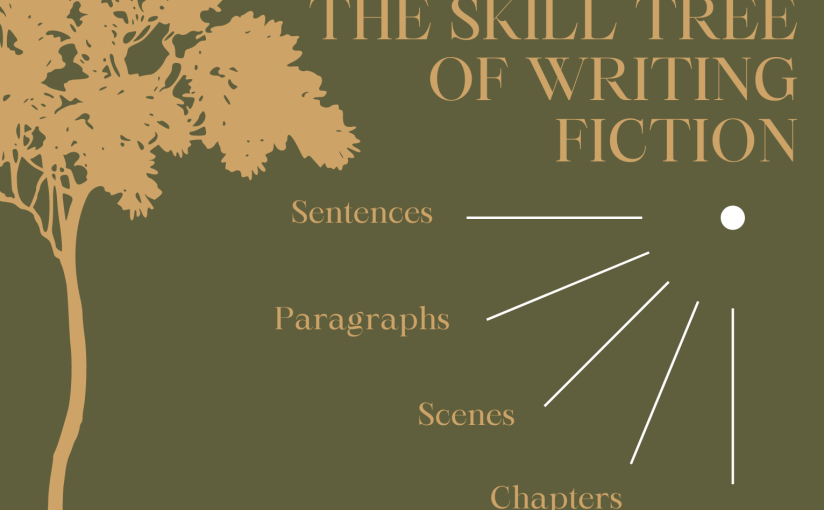
There are many aspects to writing. Last time, I discussed the concept of the writing skill tree. But one major branch of the writing tree that I forgot to mention, which is vitally important (the trunk, if you will), is actually sharing your writing.

Being willing and open to share your writing is a skill all its own.

The Anxiety of Sharing

Sharing is – for a lot of reasons – something I’ve struggled with.

It’s not just that being open to criticism in general is scary. It’s that, for me, sharing has been at times a deeply traumatizing experience, involving such extremes as public humiliation. Don’t get me wrong. I’ve gotten a lot of wonderful, positive, thorough critiques over the years, whether it’s glowing fanfiction reviews for things I wrote in college or detailed worldbuilding advice from talented friends in person. But I still feel a deep tension about sharing. I still feel a deep, unnecessary anticipation for severe, humiliating, bad-faith criticism and bullying. (And the concept of Twitter dogpiling hasn’t exactly helped.)

Anyone willing to share enough to have me beta read is already, in my opinion, pretty darn brave.

But at one point, I was frustrated with myself. I’m in my thirties! I’m not a tween! I need to stop being this way! But how?

Throw myself into the fire, that’s how. And as an all-or-nothing person, I decided to go from working-on-novels-for-years-in-solitude to share-everything-immediately-until-you-can’t-stand-it-anymore. To accomplish this type of sharing, I turned to Reddit.

Why Reddit?

I chose reddit.com/r/writingprompts, because I became deeply familiar with Reddit and its culture during my time at Ninjas. I had witnessed how unpredictable virality is based on quality, but seen how invested, fun, and engaged core communities are there compared to other parts of the internet. It’s very different from publishing an Amazon book into the void or exchanging something at a writing event, which either brings too little or too much feedback all at once.

Reddit is an interesting place. It has all types of commenters, from the helpfully critical to the kind to the downright mean, and I was completely used to seeing this kind of intense feedback rapid-fire. The /r/writingprompts community, luckily, is a kinder community than much of Reddit, with stricter rules on harassment and negative, non-constructive feedback. It has a layer of protection.

But could I handle sharing my fiction there? Would I still feel vulnerable? Could I learn to adopt the same aloof, thick-skin attitudes as my non-fictional projects?

The r/WritingPrompts Challenge

  1. Write a story based on one prompt per day. Prompts must be from that day.
  2. Stories need to be more than 100 words. Also, follow the rules.
  3. No think. Only write. By that I mean give yourself less than an hour to do this.
  4. Grade yourself. Was it good, bad, or meh?
  5. Share quickly. Do it right after proofreading.
  6. Do not crumple or devalue yourself because of a lack of upvotes. Most of the upvote game is actually about timing, which I’ll explain later.
  7. Engage with your comments. Be kind and take in criticism.
  8. Study your ticks. Learn how to become a better writer.
  9. Do it as many times as you can. I chose 30 days.
  10. While doing this, read other people’s work. Comment. Be a good member of the community.
  11. Consider submitting your own prompts. Don’t write for your own prompts, though. That’s kind of a faux pas.
  12. Have fun. This is not optional.

The Results

Besides stretching my sharing-caring muscles and avoid nihilistic sadness, I wanted to actually learn some things.

So, here’s what I learned:

Default Mode

What was my default writing like, when I was starting from scratch?

My favorite genre is fantasy, followed by science fiction. (Shocker.)

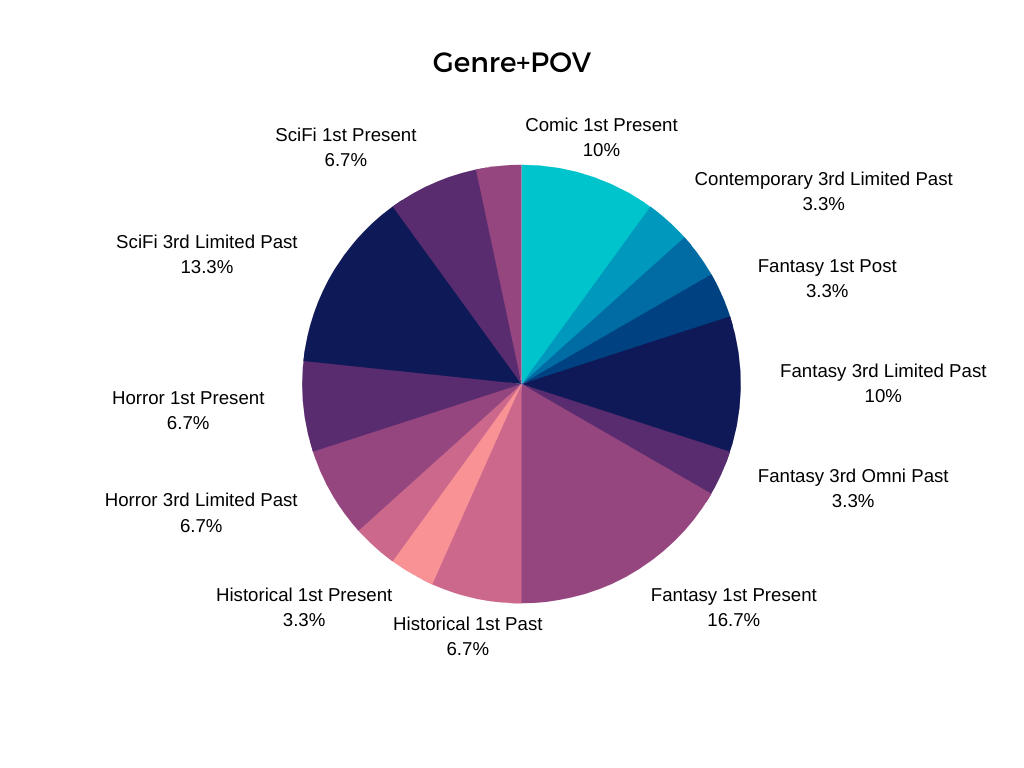
Genres: Fantasy (33%), SciFi (23%), Horror (16.7%), Historical (10%), Comic (10%), Contemporary (6.7%)

My default POV was 1st person, present tense (which is … actually surprising, I thought to myself).

POV: 1st present (43%), 3rd limited past (33%), 1st past (13%), 3rd limited present (3%), 3rd omni present (3%), 3rd omni past (3%)

The favorite combo is a POV 1st person present tense in the fantasy genre, followed by sci-fi in the 3rd person limited, past tense.

The top combos were fantasy 1st present (16.7%) and SciFi 3rd limit past (13%).

Wordcount

While it might be a good idea to get in and get out quickly, a story needs a minute to breathe, and brevity on a first draft has never been my thing.

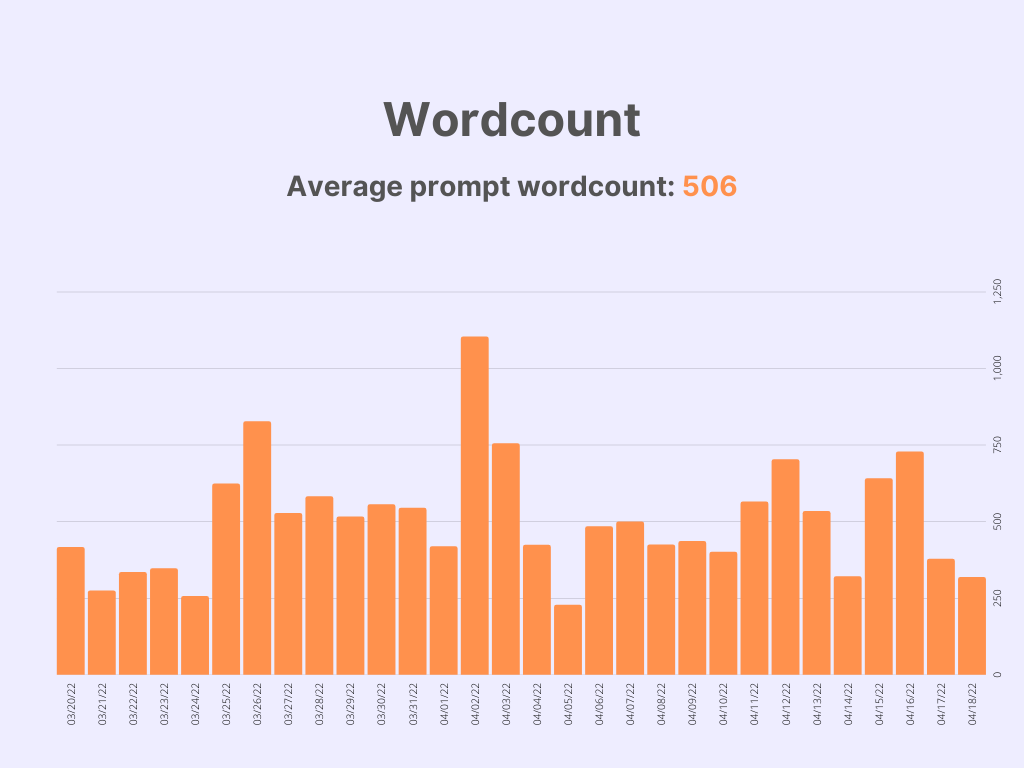
My average was 506 words.

The longest post was 1100+ and the shortest was 220 words.

I wrote a total of 15k, which is about a third of a typical NaNoWriMo month.

This is my cumulative wordcount compared to the typical trajectory of a month of National Novel Writing Month.

Karma

A note about karma: As I mentioned before, upvotes depend on a lot of factors, such as timing, and should not at all be considered a grade for quality or taken too seriously. But it’s still fun to see the data.

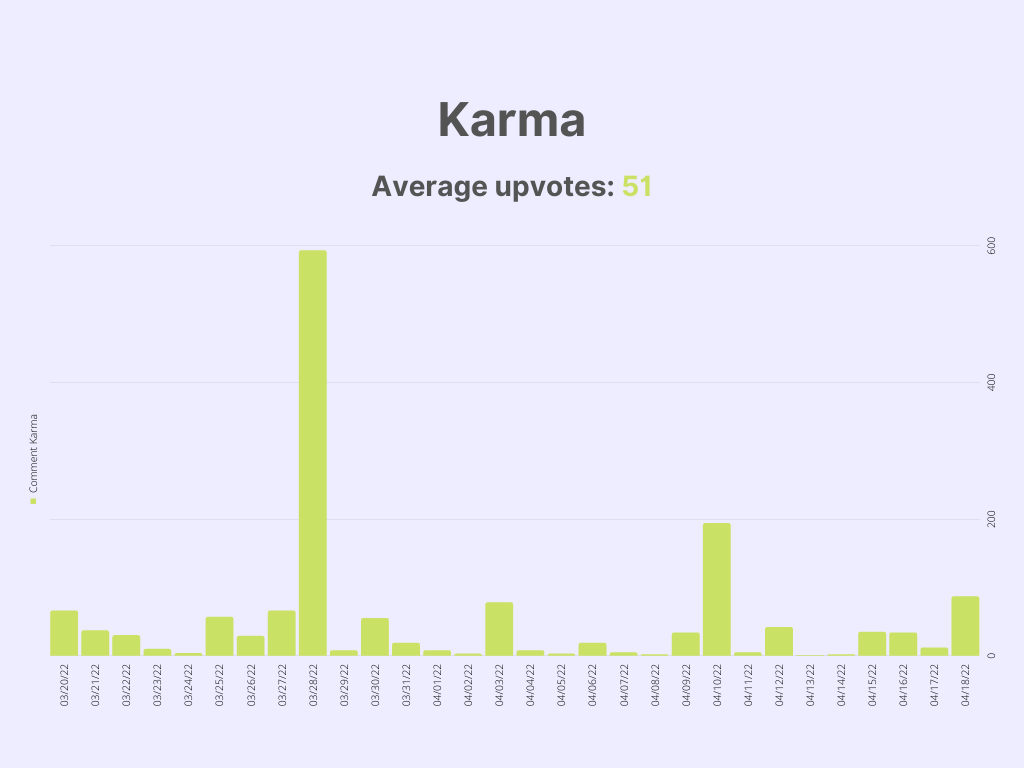
Upvotes varied wildly, the top earner being 593 and the least being 1.

Karma over time: The average was 51 upvotes.

The upvotes on your writing (the comment) depends greatly on the prompt’s upvotes (the post).

My most-upvoted comments depended on the corresponding posts earning a lot of upvotes.

A Note About Timing

Did I mention timing? While I didn’t capture a lot of timing data, one lesson I learned was that it was important to post early (the first three comments) on a quickly-rising post (before the first 300 upvotes) in order for a comment to get a significant amount of upvotes. This wasn’t always feasible – I couldn’t keep refreshing or scrolling all day. Also, I frequently completely ignored opportunities because I saw low-upvote ideas that genuinely interested me more.

Self-Evaluation

That being said, if upvotes are important to you, consider this method, but I must insist you compare against a much more important metric: what YOU think of your writing. It’s important to evaluate a piece of writing independent of others’ reactions to it, especially on the internet, which depends on timing and algorithms.

This should be done BEFORE you post something.

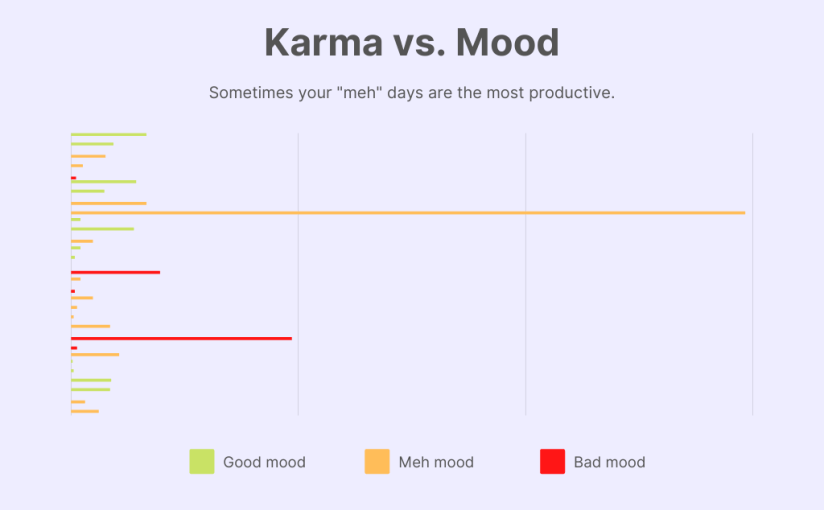
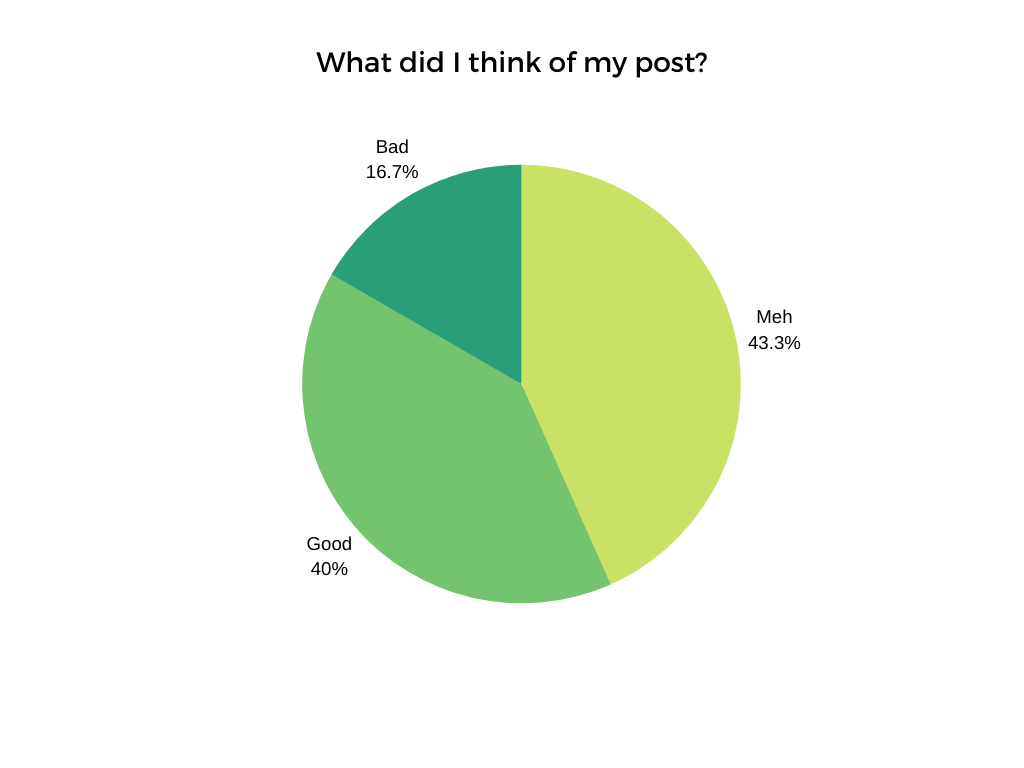
I only thought my own stuff was “good” (not great) 40% of the time.

My attitude on my piece before posting: good 40%, meh 43%, bad 16.7%

My most-upvoted posts were on days I’d graded my writing as “meh” and “bad.”

My top post in the 30 days was on a “meh” day.

This felt true as well, as one of my favorite posts was actually one of the least upvoted. I still love it though!

Now, this is a really important thing to think about. This is why so many writers insist “keep going.” Stuff that you might not think is great can still captivate, and upon a re-read might be better than you think. Don’t let writing depend on your mood. If people like Alan Moore can say it, so can I.

Representation

This stuff is very interesting, because one doesn’t typically make conscious choices to have good representation while spewing out words as fast as possible. One is leaning on subconscious, which can have a lot of stuff dangling around inside while living in our culture.

While it’s not a good idea to dwell too much on this stuff if you do this challenge yourself (what you intend to share professionally will ALWAYS be more important than what how your subconscious is responding to random posts), it still can help us be more aware of unconscious biases as we write things more intentionally. Being conscious of bias will help us write better.

So alright, let’s spill it. Here comes the cringe.

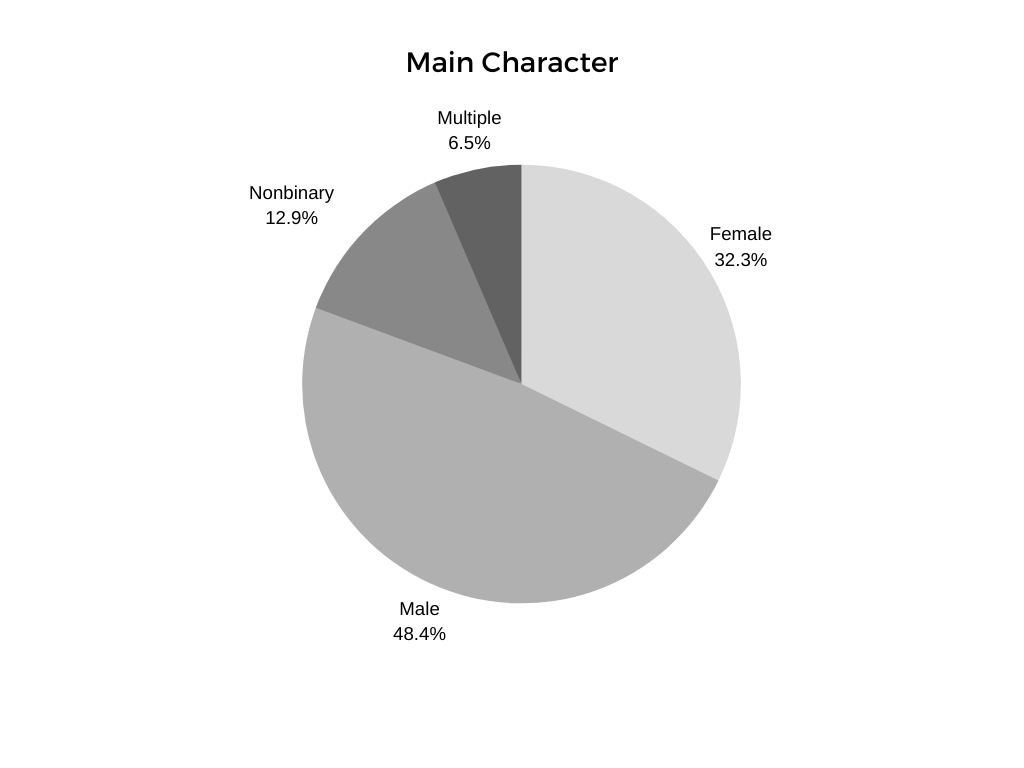
Damn, that internalized misogyny.

Men represented 48% of my main characters.

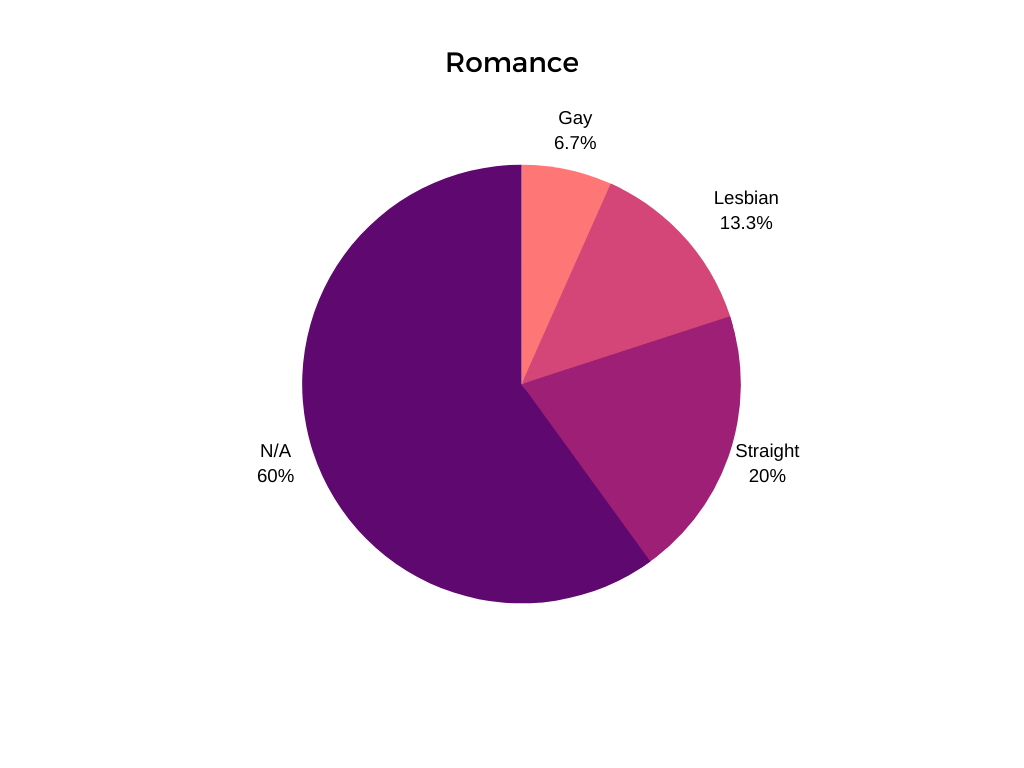
Romances leaned straight, but had more variety than I expected.

Relationships: no romance (60%), straight (20%), lesbian (13%) gay (6.7%)

Comments

I loved getting and giving comments. I had an overwhelmingly positive experience. I was surprised by the kind support.

There were a handful of negative ones but overall people were enthusiastic and supportive on the sub.

More posts got comments than not in my 30 days.

About 53% of my posts got comments.

Again, it’s very important to give comments as well as earn them.

Characters

The part of the challenge that I liked the most is that I got to know some completely new, off-my-radar characters, some of which became recurring, like Shev, the space Amazon worker with horrible manners, the pre-FTM-transition professor of magic and her necromancer crush, the Lady of Orthioc.

Naturally, some of my own characters I’d already conceptualized had wormed their way in.

And of course, it’s great to write about established characters like Batman or Screwtape.

Other Important Things I Learned About My Writing: My Ticks

There are some things I’ve struggled with consistently:

  • There are typos galore, for sure. Homonyms are a bitch, man.
  • Sometimes I have a hard time deciding on POV/tense. Often, in the middle, I’ll realize I’ll like a tense better and swap halfway through by accident. Occasionally, I’ll slip up and accidentally publish the mistake.
  • I struggle the most with character voice in my drafts. This makes a lot of sense, especially because I don’t really know the characters yet. It can be hard to make something “voicey” in a few minutes. That’s like learning to imitate someone after just meeting them. I’m finding, reading everything back, there’s a same-ness to the content. It seems like readers on Reddit and especially young readers like intense voice, rather than a “camera” that writes at a distance.
  • In order to make up for the voice issue, I lean on 1st person. But 1st present doesn’t equal “voice,” and also can have a same-ness if I don’t know the character yet. I think a lot of YA writers struggle with this issue.
  • I overwrite blocking. I knew this before – whenever cutting down my drafts I take out a lot of sighs, huffs, pouts, tooling-withs, glances, twitches, trembles, and turns. But seeing all this sloppy stuff together is … a lot.
  • When in doubt, I toss in dialogue. As a trained screenwriter, I love me some dialogue. It’s simply my default for grabbing attention and moving along a story. Only two pieces in the 30 days did not include dialogue.

All-in-all, this was a great, if not exhausting experience. I expect I’ll keep writing but on a less strict basis. For any of those who commented on my work, thank you! And perhaps I will consider creating a story centering around Francis and the Lady Grey of Othioc … we’ll see!

The Skill Tree of Fiction Writing

Everybody writes differently, and that’s so important to know when getting into it.

There is the pantser/planster/planner distinction, which is a great tool … even though it can be exhausting when people try to make the argument that one is “always better.” (They’re wrong.)

I personally had a more powerful awakening when I learned about the distinction between an over-writer and an underwriter. How often had I spoken to readers who under-wrote, who couldn’t understand my plight as an over-writer, and visa versa?

Why do these distinctions matter?

The Writing Skill Plateau

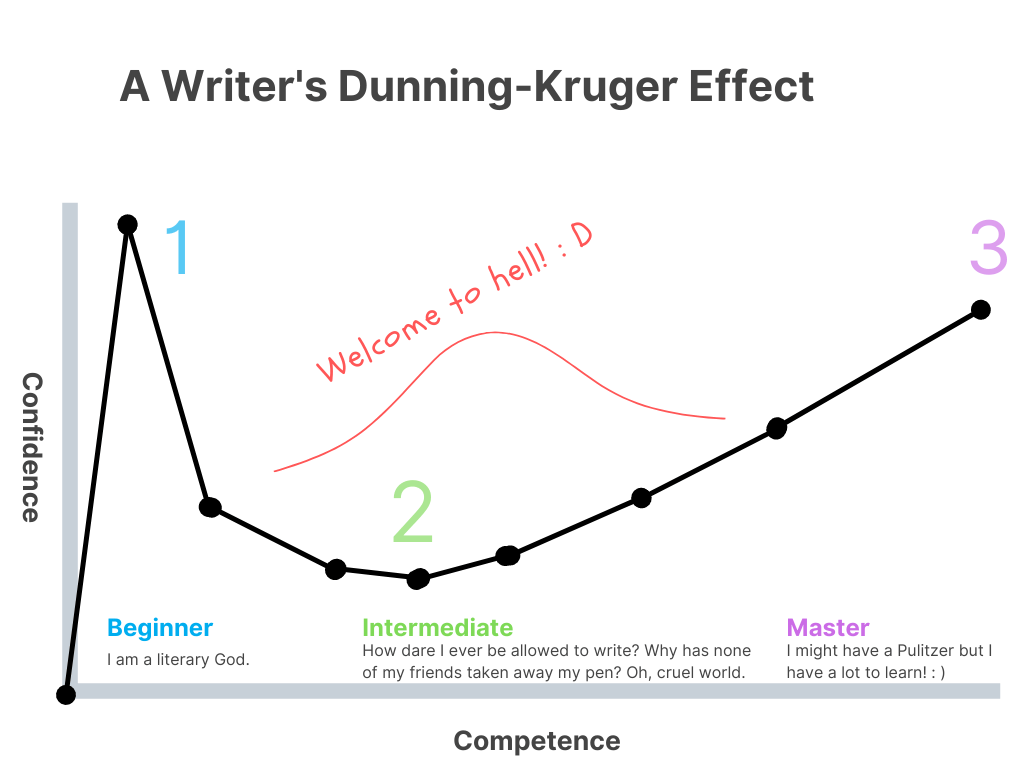
If you’ve ever read anything about the Dunning-Kruger effect, you’re probably very familiar with this chart:

Intermediate writers often suffer from rather poor confidence.

If you’ve spent any time writing your books, if you’ve ever done a #nanowrimo event, if you’ve ever trunked a novel, if you’ve ever shared your writing publicly, chances are you are far less confident than the person who is sharing their absolutely BRILLIANT short story about a sexy ghost murderer who’s dark and broody. Also there are zombies.

An entire industry has built up around capturing the not-really-novice-anymore writers and making them feel temporarily better about themselves: courses, contests, books like Save the Cat, The Emotional Thesaurus, and Romancing the Beat. They’re … fine. I’ve read most of them and bought the fancy copy of A Hero With a Thousand Faces too.

But I have a horrible secret for you: They might not work. In fact, they probably won’t, if by “work,” you think “feel better about your writing.” There’s no use getting out of this one, Mr. Frodo. You’re going to have to keep trekking Mount Doom, keep crawling up the dreaded bell curve.

What courses, workshops and books CAN do is help you learn a lot of new things about your craft. What they CAN do is help you talk to other writers who are also at the middle of that confidence dip. What they CAN do is help you try new things when you’re inevitably stuck.

There’s no shortcuts. Try new things a lot. Write a lot.

The truth is that, as writers, we rarely get to sit down with 1. pros, 2. editors, 3. agents or 4. masters. So chances are you’re an intermediate writer who’s talking to another intermediate writer.

But the problem with intermediate writers teaching each other is that we’re all in VERY different places with our skills. That’s why writers like to fixate on planner/pantser or over-/under-writers; we’re all trying to help each other out but struggling to teach each other because we’re all in different places.

This is a problem. It’s the sweetest problem in the world – the fact that we want to help each other but struggle to – but it’s a problem nonetheless.

I felt like throwing my hat in the ring to help out other intermediate writers, because I think this framework can help people communicate and learn.

Who am I? Nobody. But I’ve read/watched/listened to the fiction-writing tips of many people. And I am also a nerd. Skill tree time.

Writing as a Skill Tree

Rather than thinking of distinctions between writers, which can create some weird infighting at times, I’ve decided to conceptualize writing as a set of five core skills.

It comes from the world of video games. The idea is that you have a set of skills you choose, and that those skills are slowly leveled up.

This is an example of a skill tree from World of Warcraft. Yes, I am a nerd, okay?! *pushes glasses up nose*

The idea is that you only get a limited number of skill points, and you have to choose which skills you’re going to focus on, slowly leveling up.

Example for those who are not nerds: I am a witch. (Yes, I know this is not a DnD class, shush.) I have skills in Potions, Cackling, and Spells. I start with two points each. Every day I work on my nefarious witchy ways, I earn a point. But what if I put all of my points in cackling? I’ll have 10 points in cackling and only 3 in potions! Snape will be so mad!

Those at an intermediate level not only may be using a different style or trying to solve a different problem than you, they also may have leveled up their skill tree differently. What if they’re far better at writing sentences than you are, but they’re struggling to write a full scene? What if their chapters are baller but their book somehow sucks? What if they’re brilliant at dialogue and have a lot to teach you about it, but they can’t seem to pull off an ordinary paragraph without passive verbs?

The Skill Tree for Fiction Writing

SkillSentenceParagraphSceneChapterNovel
DescriptionWrite full, complete sentences that communicate effectively and convey style.Bunch together sentences into complete themes that don’t lose the reader.Satisfyingly convey a story in miniature, in which an event takes place (usually involving characters taking an action or in dialogue).Bunch together scenes with the effective use of transitions and slowly increasing pace/suspense.Complete longform fiction with satisfying payoff and fully finished character arcs.
Medium(s) to try outPoetry
One-sentence stories
Twitter fiction
Academic writing/essays
Articles
Poetry
100-word fiction
Journaling
Short stories
Screenwriting
Flash fiction
Novellas
Short fiction
Comics/Short graphic novels
Novels
Screenplays/scripts
Visual novels/interactive fiction
Writing ExercisesPrompt: Write one sentence 20+ different ways.
Prompt: Try magnet poetry!
Prompt: Write the LONGEST grammatically-correct sentence you can.
Prompt: Tell a full story in one sentence.
Prompt: Go to the library, pick up a book at random, scan a paragraph, and mark when your attention wandered.
Prompt: Write a one-page memo or article for a fictional authority, like the president.
Prompt: Write down strangers’ conversations (caveat: never publish it and don’t be a creep).
Prompt: Make your characters argue about a tissue box.
Prompt: Get a character from A to B, but throw 2 obstacles at them within 5 pages.
Prompt: Write for r/writingprompts!
Prompt: Read the chapter endings and chapter beginning of your favorite book. Why did you keep flipping pages?
Prompt: Write from a different character’s point of view than you had expected to use in your story and experience the story from their perspective.
Prompt: Create an outline for your favorite movie.
Prompt: Try writing the ending of your novel first.
Prompt: Record when you gave up on a book and why. Are you doing the same things?
ResourcesBuilding Great Sentences: Explore the Writing CraftGrammar Girl #639

On Writing: Dialogue Basics! by Hello Future Me

Robinette Kowal’s MICE Quotient

The Art of the Short Story
How to Structure a Chapter by Reedsy

Plot – Promises, Progress, and Payoff
Save the Cat

The Story Circle

Snowflake Method

These are what I consider to be the five core skills:

  1. Sentence building – Communicate your thought.
  2. Paragraph building – Bucket your thoughts to convey a small argument or theme.
  3. Scene creation – Tell a story in which an event happens.
  4. Chapter organization – Smoothly transition between scenes to create pacing/plot.
  5. Novel writing – Finish your story with emotional closure.

All 5 of these writing skills should, in theory, contain core story elements: a beginning, middle, and end.

Now, Steph, you might say, can’t I level up all of my skills at once when I write a novel? Well, yes. Maybe. But rarely does one have the Jack-of-all-trades skill, and usually you may be stronger in one of these areas rather than the others even after writing three or four novels. Many pro writers will tell you to just write the full novel. But some pro writers even advise against that.

I would argue that when you’re stuck, consider dumping some points into a skill that you haven’t focused on as much. Spend some time with my prompts or the resources I included.

Tips and Caveats

  • This system recommends that you write in other mediums. If you’re good at them, great! If you’re not, you’re leveling up a skill that is in your blind spot! Now, some experts suggest that you stick to one medium only. It realistically depends on how much time you have to spend honing your craft. While you should definitely spend the most “points” in your chosen genre/medium, I think widening your skills will help in the long run. That’s my philosophy, though: “A jack of all trades is a master of none, but oftentimes better than a master of one.”
  • You should actively seek resources for the skills that have fewer “experience points.” Maybe learning grammar will help you. Maybe watching movies and writing down dialogue will help you. With every skill, there are experts to rely on and skills to hone.
  • You can create your own skill tree. I highly encourage your write your own skill tree. Go nuts! The concept is ripe for the picking. (Get it? Tree joke? I’ll see myself out.) There’s many directions to go with a skill-tree concept. You can create your own rubric, including imagery, voice, pacing, etc.
  • Buff in all five categories? That’s great. There’s still more to work on. For example, this system ignores genre-specific skills like worldbuilding for the fantasy writer, suspense for the mystery writer, joke-writing for comedy writers, or scene directions for the screenwriter. There’s plenty to learn and this is by-no-means extensive.
  • Read YOUR genre/medium. There’s no shortcut to the saying “read a lot, write a lot.” If you don’t read in your genre, you’re going to struggle no matter what.
  • This system is not going to make you more confident. It will just make you better. Remember that bell curve? It’s not going to pull you out. But being frank and honest about your skills will, in the long run, likely help you.

This is simply my version of what a skill tree for fiction writers would look like. I hope other writers have fun with this and find it helpful!

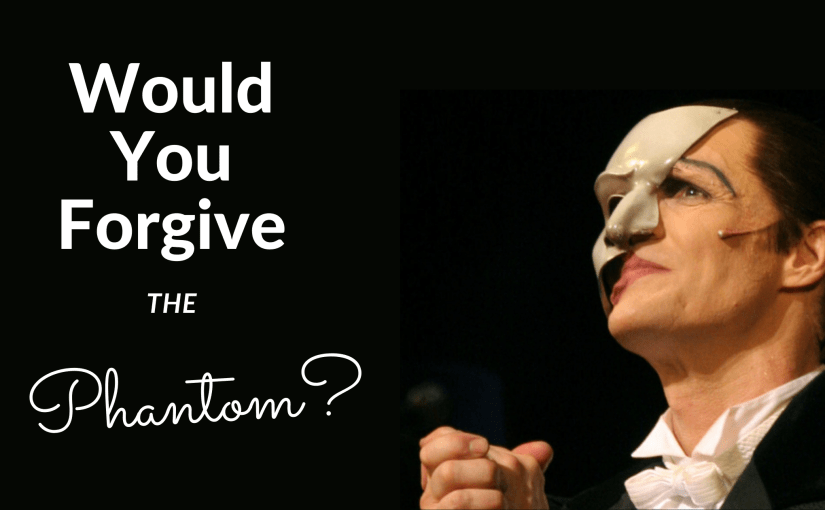
Eric, the OG Incel, and the Fetishization of Forgiveness

Every ten years or so, when the full moon wanes behind curls of fog … I return, return to the depths of my mind to conjure a memory, a melody, one I thought I had long forgotten, a place of melodramatic sighs, a place where compassion heals all wounds, a place where darkness can envelop me … and I remember singing …

BAAAA. Ba-da-da-da-daaaaaaaaaaaaaa.

Somewhat in honor of Lindsay Ellis’s retirement from YouTube, I’ve realized a few things about The Phantom of The Opera:

1. I love this trash. So much.

It’s garbage.

I had known that of course, but I came to realize just how much so recently.

It’s trash in much the same vein as Twilight or Fifty Shades, but with enough pretense for young women at the time to avoid scorn for liking it. This pulpy novel became a musical rife with sexual energy and pomp, but deserves to be looked back with a somewhat critical eye in much the same way.

It follows much of the same plot lines as either, with Eric crossing boundaries and threatening slightly more than either Edward or Christian.

People have harassed Twilight fans, Shades fans, reylo fans, and many other specifically white female loveboats. And yet, I don’t recall being mocked for loving Phantom; I even dressed as the Phantom for Halloween as a teenager. Instead of a group liking something completely pitted against a group being mocked for it, our culture seemed to be in agreement that this musical was good (at least, before the movie came out).

Perhaps it is because Eric the Phantom is framed as dangerous and bad? But that doesn’t stop our poor tween girls from lighting candles in honor of music senpai.

But forgiveness is divine, Damien!

2. It glorifies forgiveness.

Am I about to go on a ramble about how Phantom is #abusive? That’s 2014 Tumblr logic, thoughtless algorithm wars not based in reality. Antis? Shippers? Whomst? You can’t just split the world down the center, with one group marked as problematic/sinners, and one marked as the pure cinnamon rolls/elect. The world does not work that way. Gain more nuance. Who do you think you are, John Calvin?

I hope – at minimum – we’ve moved on from that sixth-grade-straight-boy level of emotional intelligence. No, I am not going to blow the case wide open, detective, by saying that the murdering monster in the basement is a bad, bad man. That should be quite obvious.

When I say “it glorifies forgiveness,” I’m talking of the “fetishization” of forgiveness (to use a phrase of Roxane Gay), wherein the concepts of empathy and forgiveness of abusive wrongdoings are typically preached to ONLY certain groups ONLY about certain people.

Forgiveness is not even. It’s not even, Steven. Steven is likely to get away with more than Julia. If Steven is a white man, he’s more likely to get away with marijuana in his trunk than many of the brown people in this country, who can’t seem to get away with wearing hoodies or holding water bottles or buying a beer. A priest might be forgiven over and over for real-life instances of pedophilia but a young gay man will be stalked and unjustly accused of it at the podium if he tries to run for office. Bill Cosby got out. Weinstein isn’t going to get nearly what he deserves. And Lindsay Ellis was bullied off of YouTube.

No, we must not cut our lines between evil and good, wherein evil is forever condemned and good is forever protected; humanity has done that for thousands of years, and no such utopia has resulted.

Forgiveness is – yes! – divine. Forgiveness congeals culture, keeps us together, and keeps the world from falling apart. It can mend ties and broken relationships. It can allow for the ending of self-inflicting pain. Forgiveness is a powerful virtue and ultimately a positive and wonderful thing. Let’s not sink into this weird #extremelyonline logic where once you are damned, you are forever damned, even if it’s tweets or posts from twenty years ago.

But we must be wiser about it.

Who we forgive, for what, and how much, defines culture.

When I say that The Phantom of the Opera “glorifies” forgiveness, the problem is not that the Phantom is #abusive (of course he is … he’s a murderer, seriously?!), it’s that the core story – the theme – is entirely dependent on a young woman who’s been mentally, emotionally, sexually, and spiritually abused to forgive a volatile and violent old man just because he has a sad backstory.

This scene where Christine visits her father’s grave during Wishing You Were Somehow Here Again (the boring one that most people start to experience theater exhaustion during) is important. It showcases how religion, patriarchy, fatherhood, and new romantic relationships with men are all intrinsically tied. Eric’s pretending to be an Angel of Music sent by her father is a form of spiritual abuse.

And we’re glorifying forgiveness in front of a group that rather shouldn’t get that message: teenaged girls. In one ultimate show of compassion, Christine Daae quells the beast that is an angry, murderous, stalking monster who has threatened her into marrying him, and that one act is enough to halt the speeding train of highly destructive behavior. Smooch. Your better now. It’s not great.

Now I’m all for humanist attitudes of providing people with their needs, base affection being an important need, but I must suggest this thought experiment:

What if Christine Daae didn’t kiss him? Would the audience hate her? Would we hold her responsible somehow? What if she stormed off like a diva? She had every damn right to. Would she be as hated as Carlotta?

Which … by the way … Carlotta did nothing wrong. Why do we hate divas? She’s great. She was just an OSHA whistleblower who almost lost her job for complaining. Hell yeah, r/anti-work keep it real, Carlotta.

This may seem like an obvious statement, but forgiveness is enforced/preached to more to those in oppressed groups.

When we say things like “forgiveness is divine,” it ends up creating cloisters of in-group forgiveness vs. out-group vindictiveness.

In other words, if you love your group, you’ll forgive, or else you will be evil – because you’re not forgiving, and forgiving is divine! Why would you be evil and not forgive him, CHRISTINE?!

This is a breeding ground for narcissistic behaviors. “Forgiveness” is absolutely vital for the abusive cycle to continue. If a mere lack of forgiveness – rather than any specific sin! – gets you kicked out of a group, then it may have this mentality.

In-Group Forgiveness vs. Out-Group “Spite”

I see these groups as circles or mini-cults, and this may affect the real-world in ways like…

  • Punishing whistleblowers
  • Retribution at accusations
  • Speeches about punishing “gossip”
  • Talks of “keeping it in the family”
    • Or, simply being told not to tell others about the behavior in order to save face
  • Attacks of character/worthiness of the accuser
  • Failure to act/respond rather than to gaslight
  • Failure to take responsibility for the harm (“that’s your problem”)
  • etc.

I, for one, believe that forgiveness is a gift, NOT something you can earn. If you can earn it, then it can be bought by social capital, which it should not be.

People who are poor in social capital are constantly taught to forgive; people who are rich in social capital are taught to be excessively strict and controlling.

When having these conversations in the real world, ask yourself: Is it safe for the person if they do NOT forgive me/us/the organization? Are they allowed to not forgive, or is forgiveness a compulsion/demand?

Do they have an option, or are they twisted every way?

I think, however, that saying this is ONLY a fetishization of forgiveness may be a little limiting/a misread of the text. Christine takes her power back in the only way she can. She’s not passive here, when she decides to tell the Phantom that she understands, that he’s “not alone” in feeling trapped. Arguably she’s led by the nose throughout the story for the most part, but her final act of forgiveness is her active participation in it. Real, true forgiveness and understand can’t be bought. It is hers to give or not give.

3. But secretly … secretly … we’re meant to see ourselves in the abuser too.

Eric is a child. By that I mean he is the ultimate definition of an emotionally stunted person. His lack of love at an early age has lead him to behave like a dangerous, clever toddler who wants mommy’s attention.

But let’s not be all “men-vs-women” about this; the secret of the Phantom is that … many girls relate to the Phantom. It’s almost like unloved girls can feel childish too.

Now, sure, I feel that a lot of women feel like they’re raising their partners, that they had to teach themselves about emotional health and now therefore have to teach the therapy-hating men in their lives the same things. It can be extremely exhausting to be a Christine. And I love, LOVE saying that Eric, by his very definition, is the OG (opera ghost) incel.

But the experience of being a Phantom is not limited to 1: being a man, 2: being in a romantic relationship, 3: feeling (or knowing that you feel) unloved, or 4: being any good at music hey hey hey hey.

An Average Human Being’s Abusive Behaviors Born From Trauma

Let us examine the strategies we see our Phantom use to “earn” Christine’s love:

  • Only allowing the other person to see you on your terms (i.e. awesome or on a cool boat)
  • Using unrelated things to sublimate/guarantee affection (ex. like a new car, or friends’ relationship, or her dead father’s violin)
  • Offering condescension and extending control rather than forming a connection
  • Lashing out as soon as your vulnerabilities are revealed (or your mask is taken off)
  • Not understanding that the other person has their own rich history, relationships and life
  • Believing that the other person is up to your whims, even if you “want what’s best” for them
  • Demanding control back when the person isn’t meeting your needs
  • Giving ultimatums (many of us aren’t as literal as grasshopper vs. scorpion, but many of us do give black-and-white ultimatums)
  • Catastrophizing (ex. “if you don’t like this behavior, then you must hate me!”)
  • Blaming (ex. “curse you, you little pandora!”)

Anyone can relate to some of these things or see the behaviors in themselves if they’re stunted, stressed, or irresponsible, whether you’re being needy with an online acquaintance or trying to get the attention of a lost relative. This is what’s fascinating about the story. It’s, unfortunately, relatable. No, we haven’t all done a murder or extorted a Paris opera house, but we have likely done a few things on the above list. Phantom is a very human baddie. There’s consistent reasons to why he’s doing what he’s doing.

That’s some great growth, kiddo. Let’s delve into that in our next session.

Unlike Edward or Christian, Eric takes the blue pill (wait did I get that right?) and actually learns how to grow up.

The *kiss* moment is quintessentially unearned, in that forgiveness isn’t often earned.

Eric experiences the full humility of this, somehow. He seems to understand at once how rare and precious the concept of forgiveness is in the first place. That he had no chance of ever “earning” it if it wasn’t given outright. That no one ever, ever, is guaranteed love for good or bad behavior. Christine is offering actual compassion rather than affection being born from compulsion, and it is better.

He has a healthy amount of guilt. He realizes that this other person should have the freedom that he’s been denied. He realizes that his controlling behavior isn’t, in the long run, going to get him love, because love is fickle and does what it wants.

(Why didn’t he understand this earlier? Eric should have watched Carmen more. Didn’t he live in the opera? I don’t know.)

I think this is the real genius of Broadway’s The Phantom of the Opera and what gives it its staying power. We get to be Eric, and experience love and understanding and forgiveness despite us feeling frantic and lonely and at our worst. We get to be Christine and take the power back from an impossible situation, in which her spiritual, physical, mental, and emotional state has been controlled by others around her, and yet she still gets to experience dignity. And we get to walk away from the theater to go buy cheesecake believing that love will save the day.

While I don’t think the real world can be fixed by one good smooch, this is a kind of New-York-grown optimism that is infectious.

Everyone regresses. Everyone can be abusive or a victim. Everyone can break the cycle. Everyone can do better.

The Ocean (or, My Thoughts on Dave Malloy’s Moby Dick, A Musical Reckoning vs. Bo Burnham’s Inside)

So, the thing that got me through quarantine is the illegal recording of Dave Malloy’s Moby Dick, A Musical Reckoning.

I saw it at Harvard in December 2019. I got sick in late January 2020. I had an angry tiff with my manager in February 2020 and started applying to jobs.

March 2020, I moved to Atlanta. That move, while it was a very wise one. deprived me of basically my entire social circle.

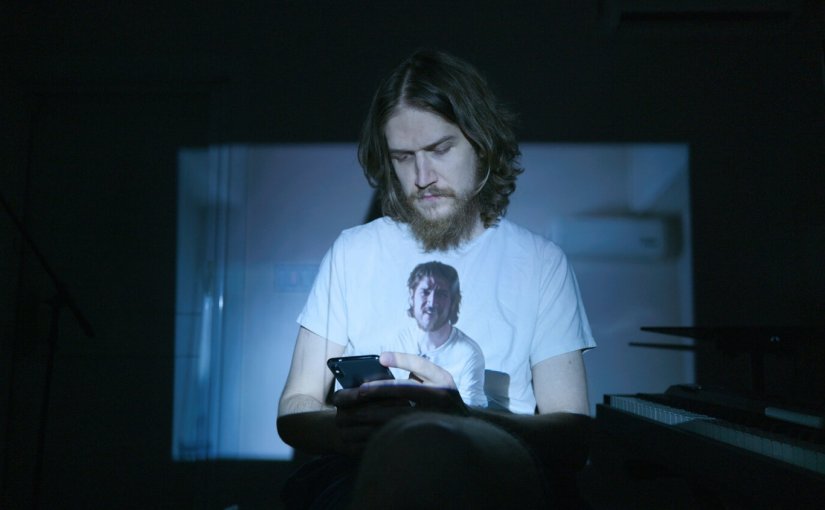
I then remained indoors and fairly isolated for the next year a la Bo Burnham’s Inside.

There’s quarantine, and then there’s quarantine when you’re single in your thirties.

Complete social isolation in a white room is considered torture for prisoners in some instances, and, to be honest, my mind hasn’t really come back from the void yet.

But I kept coming back and back to that grainy, cough-ridden, quiet, illegal recording of Moby Dick. I’d sing The Pacific to myself as I did chores. I’d allow myself to sob as Star Bubsy (Starbuck) tried to convince Tom Neils (Ahab) to turn the ship back home. I’d pensively ask myself while trying to find the right artistic work to produce, one which hopefully might make me feel whole, “Is Ahab Ahab?” I formed a deep emotional connection with this work because it outlined all my rage at the world. The story of Moby Dick is – in essence – an enormous war between man and God.

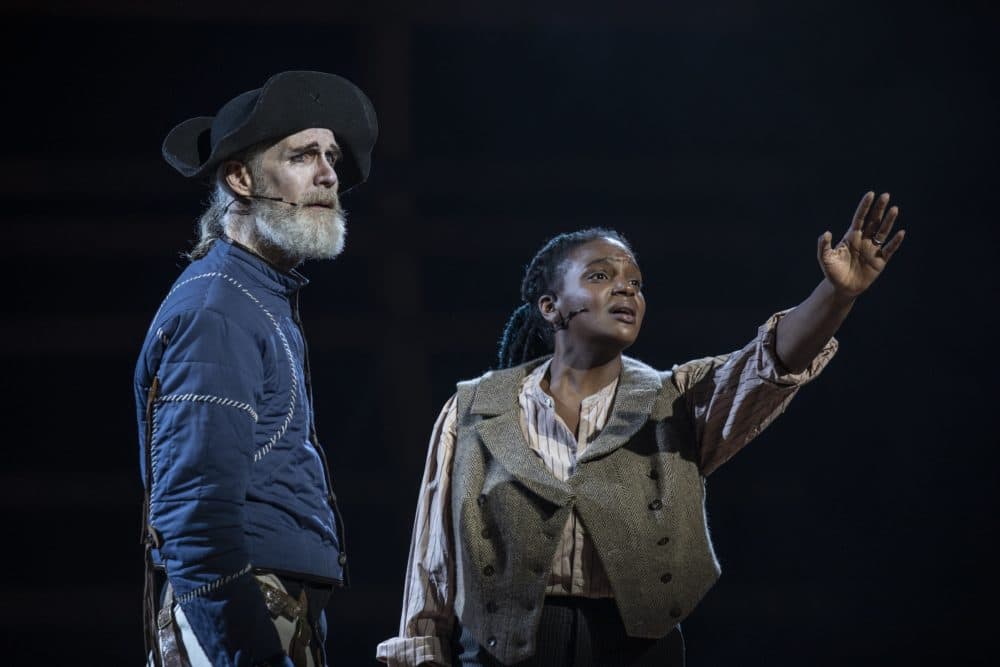
Tom Nelis and Starr Busby in "Moby-Dick." (Courtesy Maria Baranova)
https://www.wbur.org/news/2019/12/11/moby-dick-a-r-t-dave-malloy

The fact that Dave Malloy’s three-hour play hasn’t been shared widely or enjoyed a longer run is almost physically painful to me. I’ve felt a lot of genuine despair about it that I can’t really place.

Why did I – a schmuck with practically no social network – get to see Dawn L Troupe (Captain of the Rachel) sob-sing “My boy!” to a quasi-religious choir begging Ahab to stop his hate-quest and have basic human empathy? Why did I get to observe the existential-crisis-inducing flapping of a massive silk blue curtain meant to represent the truly endless ocean Pip was getting swallowed up in? Why did I get to enjoy the hilarious anachronism of stuffing a ship full of LaCroix and ramen noodles? Why did I get to see all the charming banter on the mast of a ship that hinted toward the complete despair of a trash island the size of Texas?

Moby Dick Production Photo
https://www.thecrimson.com/article/2019/12/24/moby-dick-article/

Getting to see a show like Moby Dick before COVID hit was like finding an extremely rare gem, keeping it in your pocket, trying to show people that this is a thing of value, but having no one around to appraise it. (“I don’t deserve this thing! Take it! Look at it! Someone else take it!”)

But maybe I, as a solitary fuck in 2020, was the one who would hear it the most.

I think sometimes art needs to find you at the right time in your life, and when it does, it’s electric.

I keep comparing Moby Dick to Bo Burnham’s Inside because there are a lot of similarities:

  • Existential dread, distilled
  • Global warming concerns
  • A half-shouting, half-satirical, all-confronting conversation about race that comes at the center of the show, undermining much of its misinformed white intentions
  • A deep criticism of modern ways of life
  • The prospect of absolute and total isolation
  • Despair at the refusal for societal, technological progress to slow down for the sake of human empathy
  • Distinctly liberal sensibilities, as they’re both preoccupied with difficult things that the political right would rather deny
Bo Burnham's Existential Content Crisis | Skooby Watches Movies

I think about this a lot because there’s one key difference: Bo Burnham’s Inside is, centrally, an online streaming experience, about online experiences, explicitly separated by screens and cameras, exploring what it is to be online, and now thanks to TikTok (ugh) a meme in its own right.

It’s overwhelmingly popular in the online space, with dozens of reaction videos despite the fact that this special specifically satirizes reaction videos (Dear Alanis Morrisette, I have something to report!). There’s been articles, think pieces, discussion, social shares … and continues to be more even months after its release.

Meanwhile, it’s gotten very little offline love, losing the Emmy to Hamilton.

In the special, Bo Burnham makes this extremely depressing and confrontational statement:

the outside world, the non-digital world, is merely a theatrical space in which one stages and records content for the much more real, much more vital digital space.”

There’s many ways to read that statement. Is it sarcasm? Is it not? Is a frightening, real statement that he hopes is sarcasm? Is it literally true and he’s ahead of his time? In many ways it reminds me of Oscar Wilde’s opening to The Picture of Dorian Gray in its glib, semi-literal tone that one questions. It rattles in your mind, forcing you to confront these statements, to figure out if you agree.

wishful thinker with the worst intentions — “The outside world, the  non-digital world, is...

But Dave Malloy’s Moby Dick is the 100% pure foil of InsideMoby Dick is the least “online” piece of work I’ve seen in years.

There’s very few YouTube videos of it. There’s not a Spotify list. There’s not a fandom, really. There’s almost no chatter about it on social media. There’s almost no literal web pages on it besides a handful of reviews from 2019, some song lyrics, and a wiki page.

Did it even happen?

Is Moby Dick less “real” because it’s less shareable, less represented in the digital space?

I confess that this not appearing in the digital reality almost felt like being gaslit. Why is no one else talking about this?

More importantly, why am I bothered by that? In 2002, when I fell in love with Phantom of the Opera, was it important to 14-year-old me that other people liked it? So why is it important for 35-year-old me to know if other people like Moby Dick now?

Does it mean less to me if it’s not appearing in the “much more real, much more vital digital space”?

But my silly secret Google drive file (if you ever read this, Dave, I will 100% buy several recordings of it when it formally comes out) has felt extremely real to me, even in its private, quiet form. I would argue it’s kept me alive and sane – it’s what a powerful piece of art is literally designed to do.

And besides that online experience of listening back, that night was real to me. I will never forget the tears that spewed from Dawn L. Troupe’s face as she sang to Ahab a few feet away from me. I will never forget the way the volunteers laughed at having to squish buckets of “sperm,” or the way the music vibrated off the wood and made me tremble in my seat. Or the nervousness of sitting in the cold. Or the eye contact of the actors. Or the alarmingly real puppets made out of water bottles being stabbed and spewing blood. Or the rain on the sidewalk as we excitedly left the theater to find a vegetarian bar, trying to process it all.

The cast rehearses in the studio, using a large blue sheet as the ocean.
https://news.harvard.edu/gazette/story/2019/11/dave-malloy-takes-on-melvilles-classic-novel/

It’s real. It’s valid. It doesn’t need to be online to be powerful.

This show was Theater, capital “T,” in its purest pure form – one that demands you physically be in the same room as the actors to enjoy it.

Then why do I feel such pain at Moby Dick’s lack of representation in the online space? Is it because I feel like the work is good, and should have been a meme more than that Wellerman song?

Is it because art is not memes?

Is it because I want to evangelize the work and I feel cut off from doing so in the online realm?

Is it because I secretly have a deep fear that the offline mediums are dying?

Is it because Bo Burnham’s statement is literally true?

How Bo Burnham's Netflix special Inside set the bar for quarantine art | Bo  Burnham | The Guardian

Or am I projecting, making this more personal based on my fears of producing art in outdated mediums? Am I secretly afraid of the elitist idea that humanity was once in a river of purposeful, moral artistic expression and it’s been spit out into a vast ocean of instant, meaningless thoughts?

Are we stuck alone in the ocean of information and algorithms without understanding – did the boats leave without us?

Tell me, does the ocean ever end?

Tell me, does the sky love the sea?

Tell me … can water be a coffin? Can the sky be a tomb?”

Are we getting lost in the ocean of online space?

And no one grew into anything new. We just became the worse of what we were…”

Bastian’s Reign

What would happen if you got everything you wanted?

No, I’m serious – imagine your most base, secret desire, your weirdest pipe dream, the thoughts that hide in pillowcases and shower drains, and imagine what it would be like to be given that.

Now imagine it in more detail.

And more.

And more.

Spend a good 10 minutes plotting out the logistics.

No, don’t let go. It’s not stupid. This is important. Really, think it through in detail.

How would people treat you, now that you have this thing? How much would your life change? Would you be able to handle that change? What would your life look like? What would you forget about yourself, about your journey to getting the thing, about who you really are deep down? And, most importantly, what would you desire next?

I am not trying to encourage the practice of visualization preached in The Secret. I am actually very anti-Secret, as the book plays into the fundamental attribution error, a cognitive bias that we need to overcome, and this inspires some real human verbal feces. (In short, it’s fine – delusional, but fine – to believe The Secret works for yourself; never make any assumptions about other people.)

But visualizing what you want is still very important.

This shouldn’t be difficult. We’re wired for desire, encouraged to want things from a very young age – from commercials for breakfast cereal to the sly seductiveness of native advertisements hidden in your favorite book. We are barraged with things to want constantly, told what to want. But it is difficult, isn’t it?

When was the last time you went a full day without seeing one ad? When has been the last time someone’s asked you, “What do you want?” and meant it, without trying to sell you something?

Now, I want you to keep visualizing getting your most secret desire until its most uncomfortable, realistic level.

And I want you to ask yourself: Is this dream version of you happy?

I would argue … maybe not?

Bastian's (1)


I have been working on the same fantasy series for nearly 15 years. Recently while moving from one apartment to another, I came across an old outline of the story I wrote while still in high school. The notes are messy. The characters’ names have changed. But the heart of it is the same: a sad story in which a bored teenage boy manipulates his way into heaven, only to find himself unhappy there, all why treading on divine feminine power.

I particularly like my younger self’s notes at the end:

“Happy Ending….

…kinda…”

(If that’s not my brand, I don’t know what is.)

The story plays with meta-narrative, messes with the reader, calls back to the differences between reality and fantasy, and pays with concepts like wishes, memories, subconscious desires and power.

But that’s … a story for another time.

Little did I know, I was retracing the narrative steps of a much more accomplished writer, whose work has been severely misunderstood.

Today, I wanted to write about Michael Ende’s The Neverending Story, and how it relates to so many disparate things: the philosophies of Friedrich Nietzsche, occultism, the woes of late-stage capitalism, hipster minimalism, and even that dumpster fire, Aleister Crowley.

(“Abusive Aleister Crowley and the softest of dragon puppies Falkore are somehow related?” you ask? Yes. We’ll get there.)

THAT “REVOLTING” MOVIE

That _Revolting_ Movie

You probably know about The Neverending Story via the film, because most English-speakers do. You might be interested to note that author Michael Ende called it a “disgusting” film, referring to it as “that revolting movie.” He went on to say, “The makers of the film simply did not understand the book at all. They just wanted to make money.

And his contempt wasn’t just based in aesthetic choices. He actually filed a lawsuit against the film’s creators, saying,

“My moral and artistic existence is at stake in this film.”

He lost the case.

Knowing what I know now, despite the fact that this “revolting” movie is one of my all-time favorite family films, I agree with him. He should have been angry and was right to sue. I believe he should have won.

Unlike Willy Wonka and the Chocolate Factory, Coraline, or the Harry Potter series, all of which had their authors involved in the process of film-making, this film had nothing to do with the author’s vision, or the author’s intent. It goes beyond petty complaints of an attention-sucking egotistical diva and goes more into destruction of an entire work in the public’s eyes – the whole reason copyright exists in the first place. To me, if copyright didn’t help protect the art in this case, I don’t really see the point of using copyright to protect art at all. There’s the death of the author, and then there’s the people making money off of the author’s books while pissing on his grave and saying they’re watering the flowers.

Why all the rage from Ende? What could possibly be so abhorrent as to warrant a massive lawsuit? Was Ende just being an ungrateful artist?

Let me just say that the film stops in the middle of the book. Its whole narrative, thematically, is nothing like its source material at all. Here is a short summary description of the changes:

TL;DW: After Bastian gets the seed of creation from the Empress at the end of the 1984 movie, Bastian basically turns into an anti-hero after going mad with power from all his desires, wishing himself to be the smartest, strongest, sexiest, most powerful, most influential influencer in that realm of existence. (And who’s to blame him? That’s a mood even adult me can get behind.)

bastian meme

Then he forgets who he really is, even his own name, until he learns to love his damn self, whatever that pesky “self” thing is. He struggles to get out of the hell he created for himself out of a innocent and utopic fantasy. He emerges from his fantasy world strong – not in the physical sense but in the Nietzchean sense – with a strong will and sense of self, and the thing that brings him out of this world is seeing his clinically depressed father’s tears.

WOW. WHAT A DIFFERENT THEME FROM A MOVIE THAT PREACHED TO DREAM YOUR WAY OUT OF PROBLEMS AND CHASE DOWN YOUR BULLY ENEMIES WITH AN IMAGINARY DRAGON.

Not only is the content cut in half, but the theme was also completely, utterly neutered. The Dom’s comparison of “It’s sort of like someone making a Romeo and Juliet movie and stopping at the marriage” is an accurate one. In the end, you have a film that not only doesn’t capture the source material, not only captures a different theme, but captures the complete opposite theme.

The book warns us, the readers, directly through this meta-loop of reading about Bastian, the dangers of escapism, dreaming, wishing, fantasy, and wants – that you can literally lose yourself in desire, and compassion for others is the only thing that can bring us out of that spiral of hedonism which will never be satisfied.

The movie, however, follows the same narrative that a capitalism needs: want, as much as you can, as hard as you can, as often as you can.

A Dream

Why would they gut it that much?

Well, Hollywood likes to tell us to dream. Disney’s identity is built on the concept of dreaming, even still.

  • “A Dream is a Wish Your Heart Makes” – Cinderella: This most #basic of wanting-stuff-is-good songs.
  • “When You Wish Upon a Star” – Pinocchio: This is basically The Secret for kids.
  • “I’m Wishing” – Snow White: I’m wanting.
  • “Once Upon a Dream” – Sleeping Beauty: I wanted this while it was sleeping and now wowie it’s real.
  • “Part of Your World” – The Little Mermaid: The I-want song is now happily more specific, but not really. I just kinda want to get to heaven (or land).
  • “Belle Reprise” – Beauty and the Beast: What I have now isn’t good enough and I want something vague and cool to happen to me.

I could go on and on, but you see the theme.

Dream is just another word for want in the Hollywood lexicon. If you think about it this way, content for young children in our capitalist society that’s catchy and pleasant is “Want want wishy want wish want want.”

Think of it this way and it’s … fairly disgusting, isn’t it?

What Hollywood did to The Neverending Story was to cut it up into a lovely, pre-established framework of telling kids to dream big, but they stopped completely short of telling kids what were the consequences of doing so.

That’s not new as a millennial’s experience of media as a kid. If you were growing up in the 80s and 90s, it might be fairly obvious to you, because we were subjugated to the same themes over and over, with very little regard to the severe emotional consequences and eventually lending itself to burnout culture. But the most crushing part of all this is that …

… Ende didn’t. He kept going, in a way that no one had.

The slicing up of this story and the subsequent lawsuit seem to me an obviously inevitability of capitalism’s first dying breaths. Even the less-successful, half-hearted sequel and TV show which fail to tell the second half of the story makes sense to me as a consequence.

(Oh, yeah, and if you’re wondering if the second film hits any of these themes … no.)

So what was the lesson? How are we supposed to deal with our dreams?

“DO WHAT THOU WILT”

A lot of people recognize (… and somewhat ironically buy necklaces of, and tattoo on themselves…) the Auryn, a symbol with twin snakes biting the other’s tails, which Bastian uses to fulfill his every wish.

This symbol in its book form is a reference to the Ouroboros, a Gnostic symbol used in magic that also represented somewhat of a yin-yang symbol as well as the life and death of the universe. It’s an image that’s been repeated in many subcultures and religions – Ende probably picked it up from Jung, who saw it as a mandala of alchemy.

Chrysopoea_of_Cleopatra_1download

But I don’t want to talk about just the symbol – I want to talk about the inscription written on the Auryn in the book: “Tu, was du wilst.”

That translates into English in the book as, “Do what you wish!”

Or, put another way, “Do what thou wilt.”

This is the basic tenant of Thelema, a religion/philosophy invented by none other than Mr. Crowley.

Dapper

Who is Aleister Crowley?

Once upon a time, there was a Cambridge-educated trust-fund baby from London who took a break from chess club, mountaineering, and writing pornographic poetry to learn about this hot new thing called Spiritualism. He was into it late and got a little snobby about it.

Then he visited basically any country within English control while treating anyone who was brown like a pack mule or a prostitute. And while he was out and about chilling with artists and mountain climbers who had out-and-out zero respect for him, he learned some stuff about Eastern philosophy, Egyptian religion, and magic (which he later re-dubbed “magick” because … why not?).

While he was in the Middle East, he heard his guardian angel speaking to him and decided to write it all down. (In my opinion, he probably heard about the teachings of Muhammad and thought … hey, if writing stuff and saying it was an angel worked for that guy, why can’t it work for me?) This notes from his guardian angel became The Book of the Law, the basic tenants of Thelema.

What is Thelema?

You see, Crowley had grown up in a puritanical cult where you were only allowed the bible, had no toys, and everything that came naturally to him – like enjoying nice food, bisexuality, or really sexuality in general – led him to be actively abused. He was also possibly a little autistic, and a little reactionary, and, in my non-professional opinion, a little bit borderline.

His logical response was to say “fuck the system” by writing up a religion in which sin is a myth, everything is an illusion, and basically do whatever you want. It’s kind of why punk rockers love him so much.

But it’s also kind of a sloppy system made up by someone who was abused by his mom in a philosophy that, boiled down to its essence, is basically, “Let me do what I want, mooooooom!”

Crowley, the man, was simply reclaiming a lost childhood. Thelema, the religion, is hedonism with a new anti-Christian face. Rooted in rejecting Christianity, pursuing pleasure and avoiding pain, Thelema wished to bring on a new era.

“Do what thou wilt shall be the whole of the Law.

Love is the law, under will.”

-Aleister Crowley

Yeah, so, anyways … he died a heroin addict.

That’s kinda what happens when you build a religion on only pursing pleasure and avoiding pain.

By the way, this is my reaction to reading every single biography about Aleister Crowley:

(I’m piling heaps and heaps of disrespect onto this guy, but Crowley is a complicated figure in British history. He also was fond of asthmatics and kind to women who were being mistreated by their families for their sexuality and a pretty normal father. He was … a dude. It’s important to humanize this person. But humanizing trash doesn’t make his philosophy good or sensible.)

Crowley’s Thelema and satanist teachings didn’t exactly take the world by storm, at all, though panicked conspiracy theorists would claim otherwise.

And luckily, newer versions of his religion tend to empathize personal responsibility. (I mean, Jesus … I should hope so.) But a religion based on pursing pleasure, avoiding pain, extreme individualism, encouraging double-think and alternate realities, and largely ignoring the needs of others is …

… the ideal doctrine for a privileged upper class.

Doing What You Want Under Capitalism

What’s a better message for a capitalistic society is to want, keep wanting, to know what you want, and to get what you want, fuck the consequences?

For the people in power who aren’t pursing needs but can pursue quite literally whatever they want, this isn’t to different from a doctrine you would claim organically. Besides the rituals and the dogma, what is the real difference between Thelema and the capitalist Disney ideal to dream big that we push onto children? I understand the aesthetics of the differences – singing an “I want” song as a princess is different that a Satanic cult – but what are the philosophic differences?

Because it seems to me, Crowley didn’t originate an idea, but was a symptom of a society with too much power held in one place. His philosophy wasn’t new and it wasn’t unique; it was an echo of more intelligent philosophic discussions before, during, and after his era. Crowley was a symptom, not a cause. Crowley’s ideas have gravitated to people, typically very privileged people, because his simplistic ideas affirm a growing sense that they already have: that it’s good to pursue what you want and to get it, and to not have guilt in the process.

In modern American capitalism, the doctrine of “do what thou wilt” is not only encouraged, but it may even be considered healthy! Knowing what you really want, your “true will,” even despite being told what to want over and over since birth, despite not being born with any real consumer-oriented desires, despite being crushed by the weight of so many options, can be or at least seem like an admirable quality. But it breeds this odd over-confidence not unlike what would find among the con artists of Silicon Valley.

Yes, Crowley was a trust-fund, wealth-stealing conman who funded his paradise heroin den in Sicily. Is he that different than Elizabeth Holmes, who created the completely fraud health tech company Theranos? Is the Abbey of Thelema any different than Billy MacFarland’s Fyre Festival? I don’t know. I can’t honestly say.

Capitalism is at a weird turning point. We’ll either continue to breed sociopath-like super-wealth that will make Crowley seem like Big Bird, and continue to praise our shutting off our natural empathetic responses as an admirable skill, or we will have to grow up as a culture and take responsibility for our “true will,” to respond to others’ suffering, to raise up other cultures and countries that are struggling to meet the basic human needs of their populations. In other words: will we put will over love or love over will?

Anywho, let’s get back to Bastian.

A TURNING POINT: MOONCHILD!

Now I know I’ve already introduced enough concepts for a pearl-clutching Christian to want to strip The Neverending Story from every Midwestern library, but let’s keep these things in mind: A. the story does not stop there, B. Ende shows us, in detail, the consequences of getting what we want, and C: the Auryn is an artifact with consequence, pulling Bastian’s memories and self-identity with every wish, and so the book seems to be a criticism of Crowleyan thought and capitalistic tendencies rather than any type of support of them.

At least after the film ends and the second half of the book begins, anyway.

There is a turning point in the book where Bastian and the Empress are caught in an infinity loop, living lives up until that moment over and over – which is likely based on Nietzsche’s concept of eternal recurrence – until Bastian does the right (the Ubermnesch) thing and calls out her new name.

Her new name, as a friend likes to dub, “MERHNWECHERALLLRD!” in the original version, because none of us nine-year-olds knew what he was saying in that moment. In the era of VHS, the name was hidden in thunder and swelling music. It wasn’t until one bought the DVD, threw up subtitles, and watched with a keen eye that one realized what he was saying: “Moonchild!”

And most modern viewers would say, “huh, weird name,” un-pause the movie, and leave it at that.

Moonchild was also the name of a novel written by Aleister Crowley. It was a masturbatory, ego-driven re-telling of his battle within the cult of the Golden Dawn where he demonized his rivals like W.B. Yeats. It’s also not very good.

Moonchild

The “moonchild” he speaks of is an other-worldly being conceived under magical means. Supposedly, this was based on black magic used during conception to capture the perfect soul. (Forgive me for not immersing myself Crowley’s self-important prose.)

Why did Ende chose the name Moonchild? I don’t know. I’m barely scratching the surface of the symbolic references here. Perhaps Bastian is the son of the perfect being, as Moonchild was the name of his mother. Perhaps Bastian as a character is a combination of an imperfect and perfect being.

Moonchild and The Neverending Story don’t have much in common, but  I think the painting of a calm, good, God-like figure as female is perhaps the key takeaway.

Both Crowley and Ende paint a benevolent universal force of good as a feminine energy, contrary to Crowley’s male-God upbringing. This is a re-framing of the blame-everything-on-Eve tendencies to see women as less divine than men. The scene where Bastian is handed the seed of creation happens in a garden that calls back to the Garden of Eden. That Eve/Adam narrative is completely flipped on its head.

unnamed
The official Google Doodle for The Neverending Story

Crowley was by no means respectful of women, likely only flipping the godhead’s gender to stir up religious dissent, but in The Neverending Story, the Childlike Empress Moonchild is a benevolent force and ultimately a flipped representation of an older male God.

Then, when Bastian abuses his power, when he decides to fight God, when Bastian makes the final bid to take over the Ivory Tower, which is rife with sexual imagery as the flower-shape of the castle closes to him, he is forcing his male, dominating presence on a female, divine force. We see how men oppress women, oppress the natural, oppress anyone who protects them from their desires. In the end you have a slightly more feminist story.

BASTIAN’S REIGN

Bastian spends a lot of time trying to figure out what it is he really wants. He attempt to be the smartest, the strongest, and etc., but nothing really makes him feel happy, or good. We follow him on  numerous adventures in his slow decent towards becoming a real jerk.

When the world is literally not enough, Bastian goes to attack Moonchild, or the personification of the perfect being. He wants to be in charge of this universe, or really, his own subconscious mind, but he simply isn’t. But he is simply a man railing against God (in this case, a female God). For all his wished-for strength, he is very weak.

You’re likely not a 10-year-old boy, but the attitude of pursuing one’s desires until they point where you know that they can’t possibly make you happy anymore isn’t unique to living in Fantastica. If you were given everything you wanted, would you just want more?

When will enough be enough?

“There are only two tragedies in life: one is not getting what one wants, and the other is getting it.”

-Oscar Wilde

People learning to do what they want without guilt, shame, and constriction may sound like a positive thing to a 70s hippie, but Kantian ethics and life experience tell us otherwise. And so does Ende.

The Auryn takes away Bastian’s memories. Essentially, Bastian loses himself, piece by piece, in the pursuit of his desires. It destroys him, slowly. It takes his heroics and turns him into a real monster.

The pursuit of getting what he wants literally destroys him from the inside out.

“He no longer wanted to be the greatest, strongest or cleverest. He had left all that far behind. He longed to be loved just as he was, good or bad, handsome or ugly, clever or stupid, with all his faults – or possibly because of them.

But what was he actually?

He no longer knew. So much have been given to him in Fantastica, and now, among all these gifts and powers, he could no longer find himself.”

– Michael Ende, The Neverending Story

Eventually Bastian completely loses himself and burns out on the practice of pursing his desires. (Millennial burnout for Bastian Balthazar Bux was pretty serious.)

cabernet malec

I joke, but I also don’t.

We have had more opportunity than anyone to find and learn what we want, and to try to get it, but basic needs like health, sanity, free time, and space are constantly out of reach. We are a want-based culture, not a need-based one, and it can be extremely disorienting.

We were told to dream big only to be constantly trapped in the hampster wheel of desire, all while not having basic needs met. It’s no surprise that many of us can feel like Bastian, trapped in Fantastica, ruling the world while having no control over it or our subconscious.

In a world that’s focused on pursuing pleasure and avoiding pain, it can be very easy to make mistakes.

No one told him, and no one told us, these basic truths of happiness:

  • Happiness takes self-awareness, self-kindness, and understanding of our own subconscious.
  • Happiness takes lowering expectations, not raising output to reach high expectations.
  • Happiness is a state of mind that can be reached no matter if you have what you want, so long as some basic needs are met.
  • Happiness takes practice.

Rejecting Capitalism

We find that many people are wholesale rejecting the concept of consumerism and attempting to practice more responsible capitalism. Wanting to take responsibility for our actions and reject the system is why hipsters are so obsessive about the sources of their products. Despite having hundreds of choices for clothes, many millennial shoppers will thrift shop, buy records, eat at restaurants with grass-fed, free-range chickens.

We make fun of them for it, but this is likely a positive shift. Hedonism on its own isn’t sexy; hedonism with responsibility, Nihilism memes, cultural responsibility, grass-fed chickens, thrifted overalls, calling people by their preferred pronouns, disapproving colonialism, helping the most amount of people, being a patron (or Patreon) of the arts, paying your taxes, driving a fuel-efficient car, not supporting oppressive corporations or systems, that’s sexy.

It’s not because millennial are suddenly better people than baby boomers and gen Xers; it’s a survival tactic, because if we don’t practice self-reliance, kindness, and responsibility, we will be crushed under the weight of the pursuit of our desires.

But it’s possible that responsible consumerism isn’t enough. It’s possible that we’re stuck here in Fantastica, like Bastian. How can we get out?

It’s so ironic that the generation who really needed the full version of The Neverending Story never got it.

HEDONISM AS SELF-DISCOVERY

Ende understood that getting what we want can be a terrifying thing. In a land where the subconscious fills in the landscape, Bastian’s lonely walk through the world is one of existential dread.

“You wish for something, you’ve wanted it for years, and you’re sure you want it, as long as you know you can’t have it. But if all at once it looks as though your wish might come true, you suddenly find yourself wishing you had never wished for any such thing.”

– Michael Ende, The Neverending Story

He is lost in a way that many modern people are. In America, depression is on the rise, mistrust is on the rise. We are living in an era where many of us are pursuing what we want in life and losing ourselves, like Bastian.

But then? He gets a little bit more specific with his wishes.

The last few chapters of the book are an incredible journey, because he’s making the journey from what he thinks he wants to what he really wants. 

First he unconsciously wishes for community, coming across a town of Borg-like people. Then, he realizes he wants friendship. Then, his memories. Then, a mother’s love. What he’s doing is working downwards rather than upwards on Maslow’s Hierarchy of Needs, which makes complete sense because Ende himself was a humanist. So much of Fantastica provides the upper, self-actualization portions of the pyramid, but it’s useless because Bastian doesn’t have his most basic needs met yet. Jumping up the scale is useless and exhausting. (Why have an iPhone if you have a broken foot and no way to pay for health insurance?)

In the end, he realizes that he needs something that’s at the absolute bottom of the Hierarchy of Needs, something simple and physiological: water. He needs the Water of Life.

The ultimate lesson of The Neverending Story is to learn how to be aware of, and a master of, your own subconscious, to get to know your true self (rather than your true “will”) and to learn how to be happy by fulfilling the most basic needs first. 

So, repression and avoidance of pursuing one’s desires isn’t the answer, to Ende, and neither is Crowley’s endless pursuit of pleasure and rejection of pain. In the end, learning to be conscious of what one truly wants via the path of hedonism is the path to take, and the thing that pulls it all together is empathy.

Bastian went through some horrible things, but he leaves Fantastica stronger than ever, confident he can climb down the school’s window, now having learned his own strength of character.

To end, and to others, the answer to Crowley’s bad example of hedonism is not repression and rule-setting, but more hedonism. We must dig even deeper to bury through our daily wants to figure out what it is we really need. That’s how you find happiness. But it’s quite a harrowing journey. 

So I hope you now know a little bit more about The Neverending Story, and how it’s a much more complicated and fascinating work than meets the eye. I hope we can all appreciate the deeper meaning of the original text, and take Ende at his word in that the story has much more to offer us than a great 80s riff. (Which I hope is stuck in your head right now.)

I’d like to talk more about Crowley, escapism, and my fantasy story…

…but that’s a story for another time.


Micheal Ende studied anthroposophy and had no childrenHe was married to a Japanese wife, and loved all things Japanese, especially Kabuki. He was a humanist, and it bleeds forward into his work. His father was a surrealist and banned by the Nazi party, his studio later ending up engulfed in flames. He lived through, and resisted, the Nazis.

“There were thousands and thousands of forms of joy in the world, but that all were essentially one and the same, namely, the joy of being able to love.”

  • Michael Ende

Trapped in the Dark Closet

I have a very powerful memory of coming across an enormous textbook in my school library, one that – for a moment – washed away some of my smoldering inferno of fear that had been roiling across my subconscious nonstop since I was very young. The book was Homosexuality and Civilization by Louis Crompton and it was fucking massive.

capture

I didn’t take it out of the library – I didn’t dare let my family see it. I barely even glanced at it besides shakily, casually flipping through – I didn’t want my friends to catch me in my curiosity. If I recall correctly, as soon as the librarian saw me looking at it, smiled, and began to walk over, I darted away like the little Capri-sun-sucking coward I was at fifteen. I was shook by so many emotions at once. I shuffled back to break the computer’s firewall and watch Flash animations of Foamy the Squirrel like a normal sophomore.

But the simple notion of the book merely existing struck in me such an intense certainty and resolve that I daresay I would be a very different person today if I had never seen it.

Merely by existing this title destroyed the following walls that had been built up by those around me, brick by brick:

  1. Homosexuality was a choice.
  2. Homosexuality was a recent trend.
  3. Homosexuals could easily make a different choice, but they’re sticking to their guns because they hate society, and family, and more specifically the religious nuclear family.
  4. Homosexuals were, by their very nature, promiscuous troublemakers.
  5. More homosexuals were “popping up” because, like a virus, this “problem” was “spreading.”
  6. At no point was homosexuality ever acceptable until today. We’re just a tolerant society now, which is why we allow them to exist.
  7. Marriage was always a man and a woman. No other “civil union” has ever existed and thus even that too was unacceptable.

Now, writing that out, these notions seem pretty … disgusting. Fairly gross. But early ‘00s America featured a lot of conversations churned from these axles of thought – gears, spinning wheels. Only 38% of Americans said that gay and lesbian relations were “morally acceptable” in 2002, compared to 63% today. People had pivoted their focus from race issues (in which there was no choice, and hence it was considered unethical and immoral to treat people badly based on something they had no choice over – which isn’t to say there was not racism, of course there was, but that’s a whole other can of cognitive bias worms) to sexual ones (in which people thought sexuality was a choice).

People were discussing and battling out each one of these points in turn in a variety of arenas, from academic communities to talk shows. And one of the unfortunate consequences of the LGBTQ+ community making a fast dart for acceptance in the late 90s and early 00s was that now a certain lexicon of new words had wandered into the mouths of “yer dad”’s across American dinner tables. Mine was no different.

“You know what?” my own father had said when I was around sixteen. “I do want gay people to get married!”

I was astonished – I had argued with him and his Catholic family for years at this point on the notion of civil unions being okay. (Getting them to refer to it as “marriage” was absolutely out of the question.)

“Yeah?” I asked him.

“So they can get divorced!”

(His own divorce had cost him tens of thousands of dollars and resulted in extreme emotional turmoil.)

He smugly smiled and ate a forkful of peas.

After being a part of this and so many other painful conversations, I’d realized all these narratives I’d been sold were just destroyed with one image: the words “homosexuality and civilization” on a cover of a book with nearly 700 pages of evidence.

Homosexuality was something found in nature, going back millennia, often at a fairly consistent rate. Homosexuals are unable to “choose” differently, are consistently and often members of important, structured society, often extremely accepted or even encouraged or enforced in certain cultures, and were often in a position where long-term partnerships were perfectly normal.

It’s hard to put into words how much it relaxed me. For a moment, I could raise my hands against the wall and fight it.

In an instant, I could stuff my heel into solid ground, turn, lift up my hands, and say, “No, homosexuality isn’t a new, hot thing. Erasure, antagonism, and oppression of homosexuality is the new, hot thing.”

But sometimes, evidence, confidence, and persistence isn’t enough.

Sometimes, when faced with evidence to the contrary, numb repetition becomes willfully ignorant, hateful rhetoric.

Even when I went to college, I still saw brochures for conversion therapy camps at my campus church. I would not come out as bisexual for another 10 years. To certain family members, I’m still not “out.” Some people even within the LGBTQ+ community are not super understanding about why I came out so “late.” (After all, my situation wasn’t so bad, right? No one beat me or threw me out of the house … these small things people said didn’t really matter. Most gay people are forced to accept who they are. Why is bisexuality so different?)

But ignoring the repeated phrase “this is gay; this sucks” from my peers and the quiet refusal to accept new ideas from my family members, the absolute worst part of my road of discovery wasn’t any outside force; it was self hate and repression.

Not being out is mentally, emotionally, and even physically exhausting. It was a daily weight that hung in my guts, my everyday thoughts a double-, triple-, even quadruple-think labyrinth. I frequently kid that “repression is a hell of a drug” these days, but what I mean is that policing homosexual urges, thoughts, micro-expressions, eye contact, reactions, curiosities, and actions was a consistent active role that a part of my brain was constantly dedicated to. It made my own brain an unsafe place to be in, where bad thoughts were landmines and one wrong step could land me in a spiral. I was a master at compartmentalization, and queen of rationalization, and after a while various aspects of myself genuinely began to break down – first my emotional well-being and mood, and then other aspects of my “self.” I suffered from depression, anxiety, even intense physical symptoms like exhaustion, muscle tension, and IBS. The body can only hold in so much repression at once.

In short, I was forced to internalize twin beliefs: that I had homosexual urges, and that homosexuality was bad, even evil, and thus… logically, I must be evil.

When I look back at the tapestry of late 1800s, early 1900s Western culture, I know for a fact that I was not alone in my assessment of myself … that others, for better and for worse, made the same exact logical conclusion.

According to the National Alliance on Mental Illness (NAMI)

  • LGBTQ individuals are 3 times more likely to experience a mental health condition.
  • LGBTQ teens are six times more likely to experience depression symptoms.
  • LGBTQ youth ages 10-24 are 4 times more likely to “attempt suicide, experience suicidal thoughts, or engage in self-harm.”
  • Those who faced rejection after coming out to their families were 8 times more likely to attempt suicide than those who had gained acceptance after revealing their sexual orientation.
  • Nearly a third of the LGBTQ population abuse substances, compared to 9% of the population.
  • Rates of mental health issues “are particularly high” in bisexual, questioning individuals, as well as those who do not reveal their sexual orientation or gender identity.

At the end of the day, the “just don’t think about it” rationality and the belief  that homosexual urges are a choice and the hope of “maybe it will go away” or “maybe I can train myself to not be gay” caused me to take on an intense cognitive workload, one that other people never had to take on, one that I was taking on for no good reason.

The dark closet of the mind turns normal coats into bogeymen and perfectly average needs into demonic forces; it takes your own body and makes it a terrifying place to be in.

But, listen, I am not trying to say my experience was uniquely hard…

I am living in 2019 and shit’s legit. We have LGBTQ+ sci-fi best-seller lists and Steven Universe and smash-hit fantasy authors who use they/them pronouns and fucking UNHhhh and ContraPoints and gay children’s books about penguins and queer theory classes in colleges that produce excellent books like Homosexuality and Civilization. Sure, my friends and family said dickish things, and being bisexual was hard to embrace, but life’s pretty fucking grand.

It’s not like I’m living in a time where you would be put in jail for having homosexual sex (anymore).

image
Unrelated image of Oscar Wilde

But speaking of the historical homosexual experience, can you imagine what it would’ve been like to be bisexual a hundred years ago?

aleister-crowley-young-chair (1)
Unrelated image of Aleister Crowley

Besides the sheer terror of being caught and the likelihood of discovery, can you imagine all of the internal pressures of the dark closet of the mind truly having no release? Could you imagine going through what I’ve gone through, but having no real way of crawling yourself out of it? No one to relate to, and no way to find other people like you? Believing that you were evil and debased, that your natural thoughts, which naturally turned into obsessions the more you tried to repress them, made you horrible?

Can you imagine internalizing the belief that you were evil so much that you eventually became that? If your pansexuality made you feel like a constant freak? And yet when you continued to find other people who were also sexually experimental, you began to believe everyone was a freak? You went around manipulating and abusing people for your own amusement, because the entire world to you seemed like a sick joke? You decided to abandon all notion of morality, because it was all a lie anyway, right? People had lied about this being wrong, about this feeling good, about this being okay, after all…

And what if you just … never came out? Never acted on anything? Kept up the game of that cognitive workload, never really being comfortable in your own skin, over-crafting every single word? What if history has totally lost all notion that you could have possibly been bisexual – what if beyond the occasional slight hint in a poetry verse or a strange passage in your autobiography or a odd exchange via letters or a few oddly specific circumstances in your later years, there was no real notion of the possibility of it being the case, besides the head-scratching of a blonde bisexual woman 100 years later who may relate intensely to many of these specific experiences – the obsession with masks, for instance – and consider them to be quite … odd for a straight man of his time?

The thing about LGBTQ history is that, unfortunately, there are blank gaps for obvious reasons, and “proving” someone is bisexual is always dependent on the energy and focus of an LGBTQ researcher. In other words, it’s the unfortunate fact that people are assumed straight until proven otherwise, and even then most times that different reading will not be embraced until an enormous amount of evidence has been piled up. 

There have been, and will always been, hundreds of historical people who stayed trapped in the dark closet. There was no Homosexuality and Civilization tome for them. There was no pulling out of that frightening mindspace. There was no evidence of their existence in the dark closet, just the hallmarks of the suffering, doubts, and experiences that tend to come with it.

And it’s almost impossible to drag them out. It’s a well-designed research impasse; LGBTQ+ people of certain eras were forced into the closet for their own safety, unable or unwilling to share or record any of their other sexual experiences, and modern communities will refuse someone’s alternative sexuality unless there is ample and excessive proof behind the claim.  

And even now, quietly suggesting that that person could have been something other than straight might result in intense negative reactions or personal attacks to the author.

At the same time, a fictionalized account of a story such as this might be necessary for another young person to pick up, inspect the cover, fiddle with, and decidedly run away from.

Maybe it will secretly mean the world to them.

Who knows?

Mary Belle and Blondie

Guys. Guys! GUYS! (╯°□°)╯

Check out the absolutely beautiful commissioned art done by the wonderful Céli Godfried! (and also check out her portfolio on Strikingly and follow her on Twitter)!

SHE DID SUCH A GOOD JOB!

The Madonna Updates:

Right now The Madonna has been sent out to alpha readers and so far, so good! I intend to have this project properly edited this spring.

I’m so excited to see the responses and share these beautiful people that have been trapped in my head for literal years!

I’ve also updated my project page – check it out! Hopefully I’ll be able to put up a new excerpt soon.

If you’re interested in this project, feel free to sign up for updates on my site!